

backAll Articles

Published June 03, 2024 at 03:08 PM

3 Ways DiSC Improves Strategy Execution

5 min read
5 min read

Key Takeaways

  • The DiSC model identifies four primary behavioral styles: Dominant D-styles prioritize immediate results and taking action, Influential i-styles prioritize enthusiasm and collaboration, Steady S-styles prioritize support and stability, and Conscientious C-styles prioritize accuracy and challenging assumptions.
  • Use DiSC for strength-based ownership: assign quarterly goals to the team member whose natural style fits the work, or have a detail-oriented C-style goal owner invite a decisive D-style teammate to lean in at key decision points.
  • DiSC helps leaders anticipate conflict before it happens, for example a D-style pushing for a quick decision on a new process while an S-style teammate resists the change, so you can prompt discussions that bridge the gap early.
  • People are most engaged when work aligns with their natural style: an i-style member might be energized by leading a group brainstorm on an off-track goal, while a C-style teammate prefers to brainstorm data-driven solutions independently.
  • DiSC is not about pigeonholing people; it is about appreciating the combined blend of strengths each team member brings, because self-awareness and understanding teammates' working styles improve communication and performance.

Strategic plans often turn into dust-collecting documents. To bridge the gap between planning and execution, leaders need to understand their team's natural communication styles and working preferences.
iStock-1413724971

A strong strategy is just the beginning; leveraging DiSC assessments can help you wield the knowledge of your high-performing team makeup to unlock a smoother, more effective strategy execution process. Here’s how: 

The DiSC Profile Model 

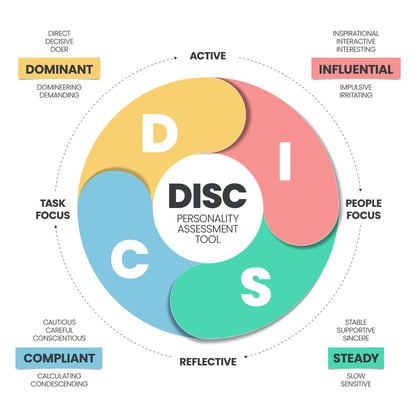
The DiSC model identifies four primary behavioral styles, each with different priorities:

  • Dominant D-style team members prioritize getting immediate results, taking action, and challenging themselves and others
  • Influential i-style team members prioritize expressing enthusiasm, taking action, and encouraging collaboration
  • Steady S-style team members prioritize giving support, maintaining stability, and enjoying collaboration
  • Conscientious C-style team members prioritize ensuring accuracy, maintaining stability, and challenging assumptions


Using DiSC to Improve Strategy Execution

DiSC steps in as a game-changer for strategy execution. DiSC goes beyond basic communication; here are three ways it unlocks a deeper level of team alignment: 

  1. Strength-based Ownership: Imagine assigning a quarterly goal to a team member who thrives on details (a C-style trait) when the execution of the goal requires a steady series of bold decisions (a D-style strength). Understanding DiSC helps you assign ownership that aligns with each member's natural strengths. In this case, it would be advantageous to assign the goal to a decisive team member or for the C-style goal owner to invite a D-style teammate to lean in at key decision points along the way. 
  2. Conflict Anticipation: Understanding DiSC styles can help leaders predict potential roadblocks. A D-style team member might push for a quick decision when implementing a new process, while an S-style teammate prioritizes stability and might resist change. By anticipating these differences, you can get ahead of these challenges and prompt discussions that will bridge the gap. This proactive approach prevents misunderstandings and keeps the team moving toward collective goals.
  3. Focused Motivation: People are most engaged when their work aligns with their natural style. An i-style team member might be energized by being asked to lead a group brainstorming session for a solution when a quarterly goal is off-track. At the same time, their C-style teammate might prefer to brainstorm data-driven solutions independently. 

DiSC isn't about pigeonholing people in a specific DiSC profile but appreciating the combined blend of strengths each team member brings toward executing shared goals with leadership vision alignment. When team members improve their self-awareness and better understand the natural working styles of their teammates, they communicate more effectively to achieve peak performance.

Frequently Asked Questions

What are the four DiSC behavioral styles?

The DiSC model identifies four primary styles, each with different priorities. Dominant D-style team members prioritize getting immediate results, taking action, and challenging themselves and others. Influential i-styles prioritize expressing enthusiasm, taking action, and encouraging collaboration. Steady S-styles prioritize giving support, maintaining stability, and enjoying collaboration, while Conscientious C-styles prioritize ensuring accuracy, maintaining stability, and challenging assumptions.

How does DiSC improve strategy execution?

DiSC unlocks a deeper level of team alignment in three ways: strength-based ownership, where goals are assigned to people whose natural styles fit the work; conflict anticipation, where leaders predict and get ahead of style-driven roadblocks; and focused motivation, where people are given work that aligns with what naturally energizes them. Together these keep the team communicating effectively and moving toward collective goals.

How should DiSC influence who owns a goal?

Assign ownership that aligns with each member's natural strengths. If a quarterly goal requires a steady series of bold decisions, a decisive D-style owner is a natural fit; if a detail-oriented C-style person owns it instead, they can invite a D-style teammate to lean in at key decision points along the way.

Can DiSC help prevent team conflict?

Yes. Understanding DiSC styles helps leaders predict potential roadblocks, such as a D-style team member pushing for a quick decision while an S-style teammate prioritizes stability and resists change. By anticipating these differences, you can prompt discussions that bridge the gap before misunderstandings derail progress.

Does DiSC put people in a box?

No. DiSC is not about pigeonholing people into a specific profile, it is about appreciating the combined blend of strengths each team member brings to executing shared goals. When team members improve their self-awareness and better understand their teammates' natural working styles, they communicate more effectively and reach peak performance.

Picture of Courtney Dyer

Courtney Dyer
Courtney is Rhythm Consulting Program Manager. With experience helping clients grow their businesses and achieve their goals. Her background is in non-profits, human resources, and technology.
LinkedIn Connect with me on LinkedIn.