

 All Articles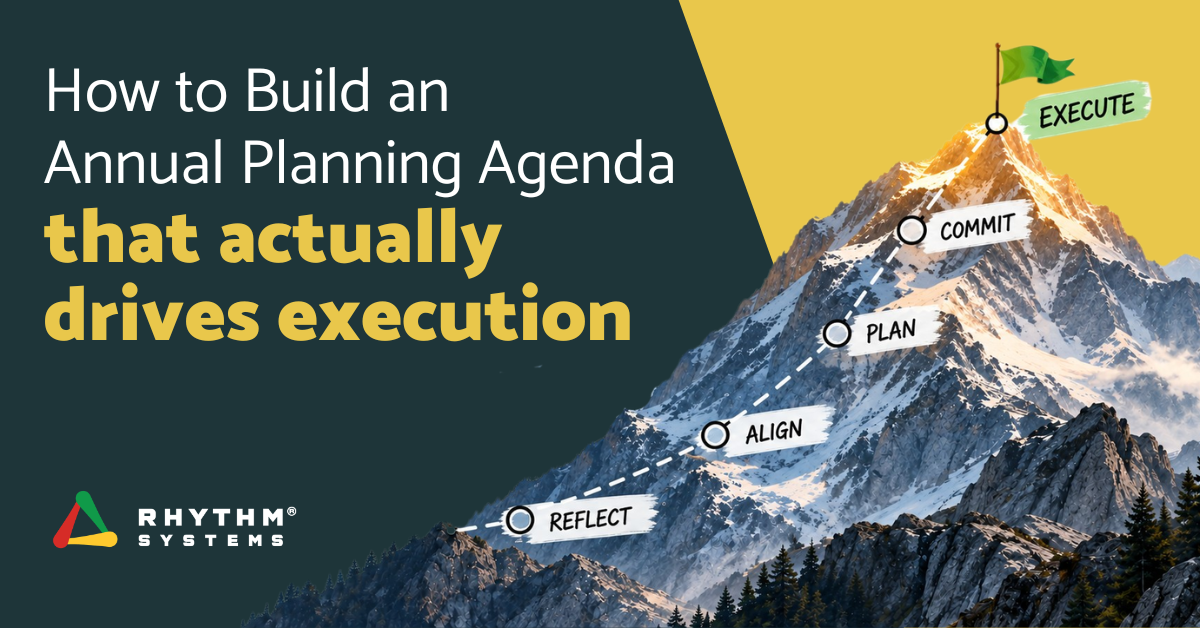
Key Takeaways
- Your annual planning agenda has one job: turn strategy into a small number of priorities your team can actually execute.
- Don't rush past your core values. They should be the filter you use to make the hard decisions that come later in the session.
- Every priority needs an owner, a clear definition of success, and a next 90-day milestone. Otherwise, it's still just an idea.
- Planning isn't finished when the leadership team agrees. The plan has to cascade so every department knows what winning looks like for the next 90 days.
The Real Purpose of an Annual Planning Agenda
I ask CEOs this question all the time.
“How did annual planning go?”
“Great. Two full days. Leadership team was there. Great conversations. Everyone left energized.”
Then I ask the question that matters:
So, what changed?
That's usually where the pause comes.
The real purpose of an annual planning agenda is to turn strategy into clear priorities, ownership, and a 90-day execution plan. It's not about filling two days with good conversation.
I've made this mistake myself. We had a great planning session, made big decisions, and left energized, but energy isn't execution. If nothing changes, you didn't finish planning.
Why Most Annual Planning Agendas Fail to Drive Execution
The majority of annual planning sessions aren't bad; they're just designed around the wrong outcome.
Look at a typical agenda:
- Review last year
- Discuss strategy
- Set goals
- Talk about next year
- Wrap up.
Nothing wrong with those topics, but what is the team supposed to produce? That's the question most agendas don't answer.
A good discussion about market opportunities doesn't automatically become a priority. A priority doesn't automatically get an owner, and an owner doesn't automatically know what needs to happen in the next 90 days. You have to design those transitions.
I've spent years helping leadership teams close the gap between strategy and execution, and I've learned that execution can't be something you bolt onto the last hour of annual planning.
Execution has to be designed into the agenda from the beginning.
The Five Moves Every Annual Planning Agenda Needs
Over the years, we've refined annual planning into five deliberate moves. The order matters.
- Look back before you look forward. Before you start dreaming about next year, get honest about this year — What worked? What didn’t work? What did we learn? What should we start doing, stop doing, and double down on doing? Where did we win? Where did we miss? What changed in our market that we need to pay attention to? You don't want to build next year's plan based on assumptions. You want to build it based on what you've learned. Reflection creates context; context creates better decisions.
- Revisit your long-term strategy — core values, core purpose, and your BHAG. This is the foundational work: does your team still believe in why you exist and where you're headed three to five years out? Skip this step, and you're building next year's priorities on sand. Ask yourself: Is this still where we’re going? Do we still believe in it. This isn’t about wordsmithing your values for three hours; it’s about making sure your leadership team is aligned on the foundation before you start making tradeoffs.
- Create a shared picture of winning. One of my favorite exercises is something we call the Destination Postcard. Imagine it’s 12 months from now and you’ve had a fantastic year. Each person describes what a great year looks like from twelve months in the future. People commit harder to a vision they can see. Build the picture first, then build the plan to get there.
- Turn the vision into priorities. Now comes the hard part. You cannot have 17 annual priorities. I don't care how important all 17 things feel. If everything is a priority, nothing is a priority. Choose the 3–5 things that will make the biggest difference this year in your business. Give each one an owner, define success clearly. Then ask: What needs to be true 90 days from now for us to know we're on track? This is where annual planning starts becoming execution. A one-year goal can feel far away; ninety days doesn’t.
- Cascade the plan and communicate. This is the step companies forget. The executive team walks out with a beautiful plan, everyone feels aligned, and the rest of the company is waiting to hear what happened. That's not execution. Your department leaders need to take the company priorities and ask: What does this mean for my department over the next 90 days? Every team should be able to see how its work connects to the company's plan. That's how you create alignment with connected priorities.
This is exactly the structure behind our own Annual Planning process, and it's why we built a free Annual Planning Agenda and a full Annual Planning Toolkit — templates, checklists, and facilitation guides — so you're not reinventing this from a blank page every January.
Why Core Values Belong at the Top of the Agenda, Not the Bottom
Here's something I've noticed after coaching hundreds of CEOs through annual planning: the teams that skip or rush the core values conversation are almost always the same teams that end up debating priorities in circles for hours. Why? Because core values are the decision filter for everything that comes after them on the agenda.
At Rhythm Systems, one of our core values is No TDC — no Thinly Disguised Contempt. It means we resolve disagreements instead of letting them fester into quiet resentment. When that value is alive in the room, a hard debate about which three priorities make the final cut stays healthy and honest instead of turning into politics. Another one of ours, Go the 2nd Mile, shapes how we talk about ownership — we don't just ask "who's responsible for this," we ask "who's going to anticipate what this priority really needs to succeed?"
You don't need our specific values — you need your values, genuinely revisited, sitting at the top of the agenda before a single priority gets debated. Be curious about whether your team still lives them. Ask directly: does this priority reflect who we say we are? An agenda that treats core values as a five-minute icebreaker instead of a real checkpoint is quietly setting itself up to produce priorities nobody feels ownership over.
There’s a Big Difference Between Deciding and Committing
This is exactly the distinction Cathy McCullough drills into every leadership team she works with, and it's a centerpiece of her Annual Planning Masterclass: a great annual planning agenda has to end in commitment, not just decision. Take a look at the clip below.
That distinction matters more than most leaders realize. Deciding on a priority is easy; you can decide on five priorities in an afternoon. Committing to one, naming an owner, defining what green, yellow, and red look like, and putting it on next quarter's calendar is where most agendas quietly fall apart.
Our Think Plan Do® methodology exists precisely to close that gap. The "Plan" isn't the finish line; it's the handoff into "Do." If your annual planning agenda doesn't end with a clear bridge into your first quarterly planning session, you haven't finished the job; you've just had a good conversation.
One Question to Ask Before Your Next Annual Planning Session
Before your next planning session, ask your leadership team one question: Does our agenda produce conversations, or does it produce commitments?
That one question will tell you almost everything about whether next year's plan has a real chance of becoming next year's results. I've watched teams transform their entire trajectory simply by redesigning how they spend those two days together, not working harder in the room, but working with more intention about what the room is actually supposed to produce.
Explore the full Annual Planning Toolkit to bring this structure into your own planning session. We’ve built the templates and tools our coaches use with growth companies so you can bring the same structure into your own planning session.
Here's to a year you actually execute, not just plan.
Frequently Asked Questions About Annual Planning Agendas
What is an annual planning agenda?
An annual planning agenda is the structured outline for a company's yearly strategy session, typically spanning one to two days that guides a leadership team from reviewing the past year through setting the coming year's priorities. A strong agenda does more than list topics; it's sequenced to produce specific, owned commitments rather than open-ended discussion.
What should be on an annual planning agenda?
At minimum, a good annual planning agenda should include a review of the prior year, a revisit of core values and long-term strategy (including your BHAG), an exercise to build shared vision for the coming year, the selection of 3-5 annual priorities with clear owners, and time to break those priorities into first-quarter milestones. It should end with a plan to cascade priorities to departments and individuals.
How long should an annual planning session be?
Most mid-market companies need one to two full days, protected from day-to-day distractions, to work through the full annual planning process. Trying to compress it into a half-day meeting usually means skipping the reflection or core values work, which weakens everything that follows.
How do you make annual planning drive execution instead of just discussion?
Design the agenda around decisions and ownership from the start, not as an afterthought. Every major agenda item should end with a named owner, clear success criteria, and for your top priorities, an immediate breakdown into 90-day quarterly milestones. A skilled, neutral facilitator also makes a significant difference in keeping the room moving toward commitment.

Patrick Thean
Patrick is an award-winning serial entrepreneur, a WSJ and USA Today bestselling author, CEO Coach, and Co-founder of Rhythm Systems.
 Connect with me on LinkedIn.