

 All Articles
I have recently been involved in a few conversations with clients that are new to the Rockefeller Habits or to long-range planning. The questions that keep coming up are "Where do I start?" and "Should I first establish my BHAG (Big Hairy Audacious Goal), 3-5 year strategic plan, Core Values, etc.?"
I think the answer varies based on the age of the company and the immediate needs, challenges and opportunities it faces, but if you're not sure where to start, here are some general guidelines for one approach you might take. All of these items are on the first three columns of the One Page Strategic Plan Template (free OPSP template), and conventional wisdom tells us to work the plan from left to right. Let's talk about why.

Core Values are part of the company's foundation, represent those things that are best about our culture, and should reflect the personality of the company. These are enduring and never change, even if our products or services do. We should be hiring and firing based on them, and they should guide how the people in our organization act and do their work. Having these in place up front helps us make better decisions and build a great company.
Next is the Core Purpose; this is the why we do what we do. Our work may change through the years, but why we do what we do should last for a very long time. The Core Purpose also captures the soul of the organization. Like your Core Values, the Core Purpose is enduring and long-term. Once you get this right, it rarely changes.
The next area to tackle would be the BHAG. Where do you want the company to be in 10-30 years? This is your Mount Everest as Jim Collins refers to it. Having this compelling Vision can help attract and retain the right people and motivate them to work toward your long-term goals. Then, setting your 3-5 year Winning Moves helps the company make progress to accomplish the BHAG as part of their 5 year plan template. Through these incremental plans, we progress towards our longer-term goal. Breaking the plan down into manageable pieces helps your team to get their arms around the priorities necessary to accomplish your goals and gives your team a chance to celebrate your accomplishments. Of course, your Annual and Quarterly Plans then feed into the 3-5 year plan, but that is as far as we'll go on this for now.
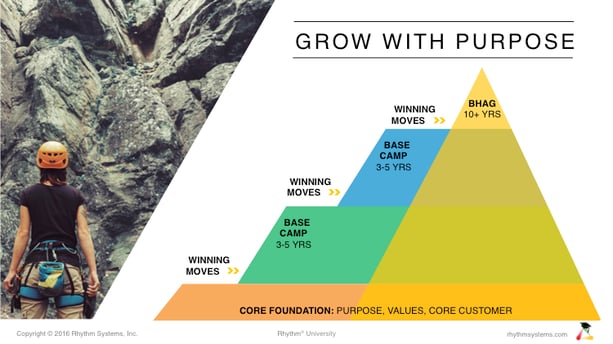
So, setting the foundation of Core Values and Core Purpose for principles that never change establishes a solid foundation to build upon. Setting a long term BHAG gives us that pinnacle or Holy Grail to work towards. Then, establishing our 3-5 year Winning Moves help us to get there in manageable increments. Once we have set our 3-5 year goals, we also want to establish measurable Targets that help us track our progress. We recommend up to eight targets balanced between the two key drivers of people and process. These would include revenue, Market Cap, Employee Health Index, Training Hours per Employee, etc. The idea is to balance the growth-oriented process drivers with the people side of the equation to ensure we build a smart, happy and healthy team to carry out our long-term goals.
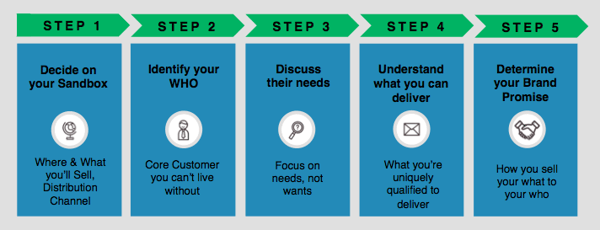
The last area I will touch on at this time is the Brand Promise. Once we have the foundation in place and establish where we are going, we need to determine how we sell our "what" to our "who." The Brand Promise should differentiate us in the market and help drive sales. The Brand Promise may not be as enduring as the core values and core purpose and may be adjusted to align with your 3-5 year goals as they change.
All of the above is an iterative process. We tell our clients that just because we get together to plan for a day or two does not mean we have all the answers or the time to refine these thoughts. Unlike an Annual or Quarterly Plan that must be completed before the period starts, we need to allow thinking time for our team to refine and discover the areas of our long-term plan. It is more important to slow down and get it right than it is to get it done.
The order you attack these items may vary based on your company's specific needs, but these guidelines may give you some direction if you are not sure where to start. Good luck, and plan well!
Download the free One Page Strategic Plan Template or OPSP Template Word to help power your Rockefeller Habits and Scaling Up. Getting your business vision into a one-page strategy takes time, thought, and careful consideration of your chosen words.

Alan Gehringer
Alan is a Rhythm Consultant. He has years of experience helping clients get into a strong Think Plan Do Rhythm to profitably grow their business with purpose. He is an expert meeting facilitator, critical thinker, lifelong learner and a good listener. He is committed to helping clients reach their business goals by drawing on his experience and family business background.
 Connect with me on LinkedIn.