

 All Articles
Some of the most successful companies in the world are chasing goals so audacious they didn't know how they'd get there when they set them. Amazon's founding BHAG was to make every book ever printed, in any language, available in under 60 seconds. Microsoft's was a computer on every desk and in every home. NASA's was landing a man on the moon and returning him safely to Earth — a goal set years before anyone knew how it would actually happen.
This is the power of a BHAG (Big Hairy Audacious Goal, pronounced "bee-hag"): a term coined by Jim Collins and Jerry Porras in their book Built to Last: Successful Habits of Visionary Companies. A BHAG serves as a unifying focal point that aligns your entire organization around a single, ambitious mission for the next 10 to 25 years.
If you're wondering "What is a BHAG?" or struggling to articulate compelling long-term business goals for your organization, the right examples can provide the inspiration you need. Whether you're setting your first 10-25 year vision or resetting after accomplishing a major milestone, understanding how successful companies craft their BHAGs will help you create one that energizes your team and drives sustained growth.

Why Your Long-Term Strategic Vision Needs a BHAG
A well-crafted Big Hairy Audacious Goal does more than set a target—it creates a sense of urgency and excitement that transcends traditional stretch goals. As Collins and Porras wrote, "The envisioned future should be so exciting in its own right that it would continue to keep the organization motivated even if the leaders who set the goal disappeared."
The best long-term business goals share these characteristics:
- Audacious enough that you can't see exactly how you'll achieve them
- Clear enough that everyone knows when you've succeeded
- Aligned with your core values and what you can become best in the world at
- Inspiring enough to maintain momentum for 10-25 years
Don't let your team fall into complacency after reaching one BHAG. Celebrate your success, then reset with an even bolder vision. This habit of maintaining an ambitious long-term strategic vision is what separates visionary companies from the rest.
The 4 Categories of BHAGs (with Examples)
Collins and Porras outline four distinct types of Big Hairy Audacious Goals in their book Built to Last: Successful Habits of Visionary Companies. Here's how each category works, along with classic and modern examples.
1. Target-Oriented BHAG
This is the most common type of BHAG, where you set either quantitative (numerical) or qualitative targets as your long-term business goals.
If setting a revenue target, ensure it genuinely thrills your team - keep in mind most people besides the ones who benefit directly won’t find revenue in itself inspiring. For qualitative targets, establish tangible measurements so you'll know when you've achieved success—just like NASA knew when they landed a man on the moon and returned him safely to Earth. You can only hit a target if you know exactly what it is.
Classic examples:
- Become a $125 billion company by year 2000 (Walmart, 1990)
- Land a man on the moon and return him safely to Earth (NASA, 1960s)
- Become the dominant player in commercial aircraft and bring the world into the jet age (Boeing, 1950)
Modern example:
- Achieve carbon negative status — removing more carbon than it emits — across its entire value chain by 2030 (Microsoft's sustainability BHAG, announced 2020)
2. Competitive BHAG (Common-Enemy)
This type of Big Hairy Audacious Goal rallies your team around beating a larger competitor—a David versus Goliath mentality that can be incredibly motivating. This works especially well when there's a clear industry leader whose market share you're pursuing.
Classic examples:
- Crush Adidas (Nike, 1960s)
- Yamaha wo tsubusu! We will destroy Yamaha! (Honda, 1970s)
- Knock off RCA as the number one company in electronics (Sony, 1950s)
Modern example:
- Overtake Tesla as the world's leading electric vehicle manufacturer (Rivian's implicit long-term strategic vision)
3. Role Model BHAG
Perfect for emerging organizations, this category focuses on aspiring to be like great companies. Rather than direct competitors, think about companies known for excellence in the ways you want your company to excel.
Classic examples:
- Become the Nike of the cycling industry (Giro Sport Design, 1986)
- Become as respected in 20 years as Hewlett-Packard is today (Watkins-Johnson, 1996)
Modern example:
- Become the Patagonia of the tech industry—profitable, purpose-driven, and planet-positive (Various B-Corp tech startups, 2020s)
4. Internal Transformation BHAG
Best suited for larger, established companies, this type of BHAG focuses on fundamentally changing how the organization operates. This can apply to an entire company or a division seeking transformation within a larger enterprise.
Classic examples:
- Transform this company from a defense contractor into the best diversified high-technology company in the world (Rockwell, 1995)
- Transform this company from a chemical manufacturer into one of the preeminent drug-making companies in the world (Merck, 1930s)
Modern example
- Transform from a legacy hardware and IT-services company into the essential hybrid cloud and AI platform for the enterprise (IBM's transformation under CEO Arvind Krishna, 2020-present)
Contemporary BHAG Examples: Long-Term Business Goals from Today's Leaders
Looking at how modern companies set their Big Hairy Audacious Goals can provide fresh perspective for your own long-term strategic vision.
SpaceX: Making Life Multi-Planetary
The BHAG: Establish a self-sustaining city on Mars with a million people by the 2050s.
Elon Musk's vision for SpaceX goes far beyond launching satellites. Through developing reusable rockets with the Starship program, SpaceX is methodically working toward making humanity multi-planetary. This represents one of the most ambitious long-term business goals in modern history—a true 25+ year vision that inspires employees, investors, and the public alike.
OpenAI: Ensuring AI Benefits Humanity
The BHAG: Build artificial general intelligence (AGI) that benefits all of humanity.
Since its founding, OpenAI has maintained this audacious long-term strategic vision. With the release of GPT-4 and ongoing research into AI safety and alignment, the company continues pushing toward a goal that seemed like science fiction just years ago. This BHAG drives every product decision and research priority.
Stripe: Growing the GDP of the Internet
The BHAG: Increase the GDP of the internet.
Rather than focusing on market share or revenue targets, Stripe's Big Hairy Audacious Goal centers on expanding the entire digital economy. By building infrastructure that makes online commerce accessible to businesses worldwide, Stripe measures success by the collective growth of all internet businesses—a truly visionary approach to long-term business goals.
Shopify: Making Commerce Better for Everyone
The BHAG: Make commerce better for everyone by arming rebels—entrepreneurs who challenge the status quo—with the tools to compete against established players.
Shopify's long-term strategic vision focuses on democratizing commerce by empowering independent businesses and entrepreneurs. This BHAG has driven their expansion from simple e-commerce tools to a comprehensive commerce platform serving millions of merchants globally.
NVIDIA: Powering the AI Revolution
The BHAG: Become the essential computing platform for artificial intelligence and accelerated computing across every industry.
NVIDIA has transformed from a graphics card manufacturer into the backbone of AI infrastructure. Their long-term business goals center on being the fundamental technology enabling AI advancement—from autonomous vehicles to drug discovery to climate modeling. This transformation demonstrates how an internal transformation BHAG can redefine an entire company.
Patagonia: Using Business to Save Our Home Planet
The BHAG: Be in business to save our home planet while running a profitable company that inspires environmental action.
Patagonia's Big Hairy Audacious Goal integrates purpose with profit in a way few companies achieve. Their 2022 decision to transfer ownership to trusts dedicated to fighting climate change represents the ultimate commitment to this decades-long vision—proving that authentic long-term strategic vision can drive both impact and business success.
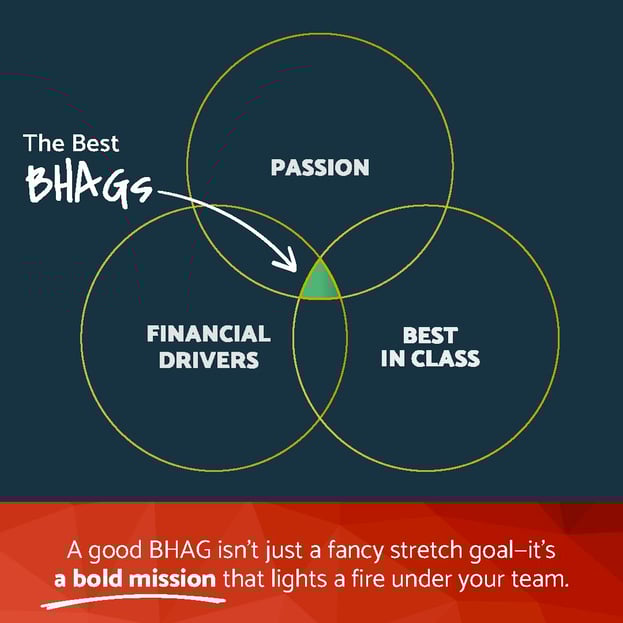
What Makes a BHAG Work: The Hedgehog Concept
A great BHAG doesn't come out of nowhere — it has to be grounded in what Jim Collins calls your Hedgehog Concept, a term borrowed from Isaiah Berlin's essay "The Hedgehog and the Fox." Fox companies chase every opportunity and end up scattered. Hedgehog companies know one big thing well, and use it as a filter for every decision.
Three questions get you there:
- What can you be the best in the world at? Not what you're already best at — what you could become best at, if you focused everything on it.
- What drives your economic engine? Jim Collins frames this as a single ratio — profit per X — that has the greatest sustainable impact on your business if you systematically increase it over time.
- What are you deeply passionate about? Not manufacturing passion for the work, but choosing work your team is naturally inspired by.
The intersection of these three answers is your Hedgehog Concept — and it's the foundation your BHAG needs to sit on. Once you know it, test any BHAG idea against these questions (drawn from the Jim Collins Vision Framework):
- Do you find this BHAG exciting?
- Is it clear, compelling, and easy to grasp?
- Does it connect to your core purpose?
- Would it be exciting to a broad base of people in the organization — not just leadership?
- Does it pass the "Mount Everest Standard" — is it a real audacious goal, not a wordy mission statement?
- Do you believe you have less than a 100% chance of achieving it (50–70% is the sweet spot) — but still believe you can achieve it if fully committed?
How to Create Your Own BHAG
Ready to develop your company's Big Hairy Audacious Goal? Here's how to get started:
- Align with your core values and purpose: Your BHAG must reflect what your company stands for and what you can become the best in the world at—your hedgehog concept.
- Think 10-25 years out: Long-term business goals require an extended time horizon. If you can see exactly how to achieve it in 3-5 years, it's not audacious enough.
- Make it measurable: Whether quantitative or qualitative, ensure you'll know when you've achieved it.
- Get your team excited: Test your BHAG with employees. Does it energize them? Would it keep them motivated even if current leadership left?
- Choose the right category: Select the type of BHAG—target, competitive, role model, or internal transformation—that best fits your organization's stage and circumstances.
- Review and monitor regularly: Discuss your Big Hairy Audacious Goal at annual planning sessions, monitor progress quarterly, and reference it in weekly meetings to keep it alive.
Keep Your Long-Term Strategic Vision Alive
A BHAG isn't something you set and forget. The most successful companies make their Big Hairy Audacious Goal a living part of their culture by:
- Connecting daily decisions to the long-term strategic vision
- Celebrating milestones on the path to achievement
- Adjusting tactics while maintaining the core vision
- Communicating the BHAG consistently to all stakeholders
Remember, you don't need a moon mission to create an audacious goal—just something big enough that you're not entirely sure how you'll get there. If the path forward is completely clear, your goal isn't bold enough.
At Rhythm Systems, we help mid-market companies accelerate growth through strategy and execution software that keeps your long-term business goals on track. Download our BHAG template to get started, and let us know how your journey unfolds. We're always looking for patterns and better ways to help our clients develop winning strategies.

Jessica Wishart
Jessica is Senior Product Manager at Rhythm Systems. She has experience in Client Services and Rhythm software technical support. Her background is in Organizational Execution.
 Connect with me on LinkedIn.