

 All Articles
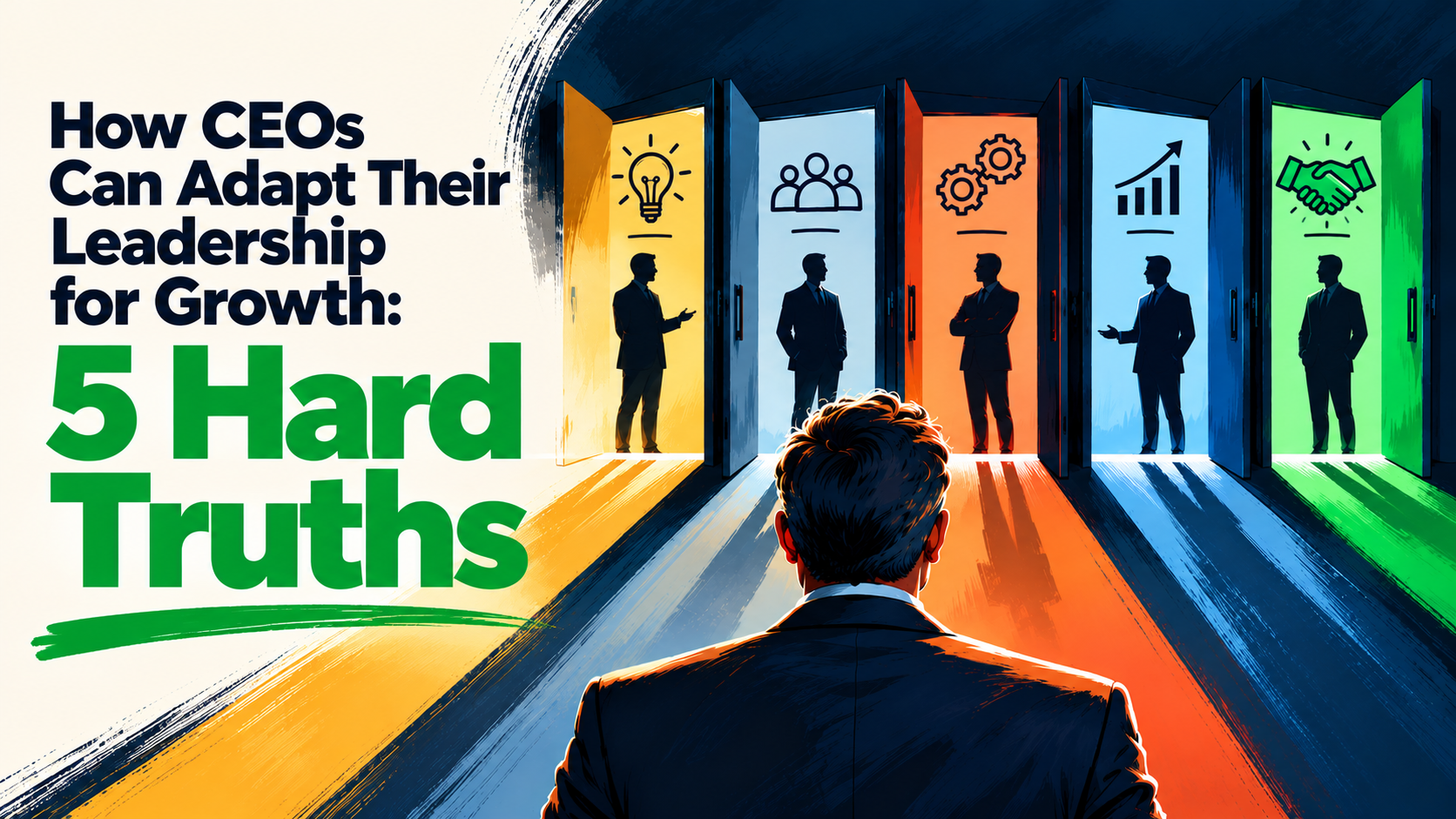
Key Takeaways
- Growth requires testing ideas before everyone agrees. Jackrabbit Technologies got one positive reply out of 3,000 emails for its first web-based product. The lesson for CEOs is to run small, disciplined tests with forward-thinking customers instead of waiting for unanimous approval.
- The culture you started won’t sustain itself. As a company grows, culture needs intentional habits, like the company book club SWF Industrial uses to build relationships between people who rarely work together.
- Your company can’t scale if every decision still needs you. Delegating authority, not just tasks, lets your leaders own outcomes. Gallup found that companies led by CEOs with high delegator talent generated 33% more revenue.
- Having the answer isn’t the same as developing a leader. When someone brings you a problem, ask what they think is happening and what they recommend before you offer your answer.
- Your team measures your leadership by your follow-through. Trust is built through consistency, action, and behavior aligning over time, not through one inspirational speech.
The Next Level of Growth Requires a Different Level of Leadership
The best leadership lessons don’t always come from a business book. Sometimes they come from another CEO who has already made the mistake you’re about to make.
That’s one of the things I love most about hosting The Journey to CEO Success podcast.
Every conversation reminds me that no matter the industry, company size, or stage of growth, CEOs wrestle with many of the same challenges. How do I keep innovating? How do I build a great culture? How do I let go? How do I develop leaders? How do I build trust when things get tough?
Adapting your leadership for growth means shifting from making every decision and reinforcing every habit yourself to building the leaders, habits, and systems that let your company grow beyond you.
This October, I had the opportunity to sit down with five incredible leaders across five very different industries:
- Youth activity software: Mark Mahoney, Co-Founder and CEO of Jackrabbit Technologies
- Metal fabrication: Brandon Stanchock, CEO of SWF Industrial
- Defense cybersecurity: Nate Shea, Founder and CEO of SecureStrux
- Fire detection: Ollie Murray, International Director at Hyfire
- Fishing gear: Dave Mellon, President of Simms Fishing Products and Revelyst Outdoor Performance
Each one handed me a different lesson. Together, they read like a playbook for growing a company without losing yourself in the process. Here are the five hard truths I’m taking into 2027.
Hard Truth #1: Growth Requires Testing Ideas Before Everyone Agrees
Imagine sending 3,000 emails to validate a new business idea and getting ONE positive response.
That’s exactly what happened to Mark Mahoney, co-founder of Jackrabbit Technologies, when he proposed moving his gymnastics class management software to the web in 2004.
Most people would have taken that as a sign to move on, but Mark didn’t. Instead, he paid attention to the one customer who saw the opportunity.
Today, Jackrabbit serves 25,000 locations across 37 countries, after more than two decades of bootstrapped growth.
What I loved about my conversation with Mark was his approach to innovation. He doesn’t try to make everyone happy. He finds the customers who embrace change, tests ideas with them, and learns quickly.
He’s applying that same thinking to AI today, testing multiple concepts with a small group of forward-thinking customers before investing heavily.
Innovation isn’t a popularity contest.
As your company grows, protecting what already works can become more comfortable than testing what comes next. Your job isn’t to dismiss customer feedback or wait for unanimous approval. It’s to create a disciplined way to test ideas with customers who are willing to try something different.
One positive response isn’t proof that an idea will succeed. It can be a reason to run the next test.
As CEOs, we need to know the difference between listening to our customers and letting our customers dictate our future.
My question for you: Where are you waiting for broad agreement when a small, focused test would help you learn?
Listen to the complete Episode #69 with Mark Mahoney here:
• Apple: https://bit.ly/3GB5W0P• iHeart Radio: https://bit.ly/40eTeLU
• Spotify: https://bit.ly/4lqkhfM
Hard Truth #2: The Culture You Started Won’t Sustain Itself
Brandon Stanchock, CEO of SWF Industrial, shared with me, “Culture is a byproduct. It’s a symptom of the health of the organization.”
I couldn’t agree more!
Brandon isn’t someone who naturally loves reading. So what did he do? He started a company book club. Twice a week, employees come together virtually to discuss what they’re reading. Some join from the shop floor, others from their cars. Participation has grown from six people to as many as 35.
But here’s the interesting part: the biggest benefit wasn’t necessarily the books. It was the relationships being built between people who otherwise might never interact. A shop fabricator and the person who handles timekeeping, who rarely cross paths, now know each other. That’s culture in action, built twenty pages at a time.
As a company grows, you can’t rely on everyone having the same access to you, or to one another. The culture that once developed through daily contact needs more intentional habits. Brandon’s book club is one example: a recurring opportunity for people to build relationships across roles.
Brandon didn’t leave those connections to chance. He created a recurring habit that brought people together.
Culture isn’t a switch, and that’s exactly why it’s a competitive advantage. Your competitors can’t buy it off the shelf. I often tell CEOs that your company culture is the result of the behaviors you consistently tolerate, encourage, and reinforce. You can’t write a few core values on the wall and expect people to live them. You have to create the habits and rhythms that bring those values to life.
My question for you: What part of your culture still depends on your personal presence, and what habit would help your team carry it forward?
Watch the complete Episode #70 with Brandon Stanchock here:
• Apple: https://bit.ly/3GB5W0P
• iHeart Radio: https://bit.ly/40eTeLU
• Spotify: https://bit.ly/4lqkhfM
Hard Truth #3: Your Company Can’t Scale if Every Decision Still Needs You
Nate Shea, founder of SecureStrux, spent his early years doing client work all day and running the company at night.
Sound familiar?
As entrepreneurs, we get really good at doing everything ourselves. That’s often how we survive the early years, but the very thing that helped us build the business can eventually prevent it from growing.
Nate realized he had to stop delegating tasks and start delegating authority. There’s a BIG difference.
Delegating tasks means someone else does the work, but you’re still making every decision. Delegating authority means trusting your people to own the outcome.
Letting go doesn’t mean removing accountability. It means agreeing on the outcome, clarifying which decisions the other person owns, and deciding when they should bring an issue back to you. You stay accountable for the business without remaining the approval point for every decision.
Nate also learned to accept that someone else’s 80% solution could be good enough, even if it wasn’t exactly how he would have done it. That doesn’t mean accepting lower standards on everything. It means recognizing when a different approach can meet the agreed outcome, even if it isn’t the approach you would have chosen. That’s not easy for a founder to get comfortable with. I know because I’ve struggled with it myself!
For years, I connected my value to how much I personally contributed, but as a CEO, your job isn’t to be the best individual contributor. Your job is to build a team that can win without you being involved in every decision.
Mark Mahoney experienced something similar. After more than a decade of trying to be both the visionary and the operator, he was burned out and considering selling his business. Stepping away from day-to-day operations changed everything.
The data backs this up. Gallup studied 143 CEOs on the Inc. 500 and found that companies led by CEOs with high delegator talent generated 33% more revenue. You can’t scale a business if you refuse to scale your leadership.
My question for you: Which decision still waits for your approval, and what would someone else need to own it confidently?
Watch the complete Episode #71 with Nate Shea here:
• Apple: https://bit.ly/3GB5W0P
• iHeart Radio: https://bit.ly/40eTeLU
• Spotify: https://bit.ly/4lqkhfM
Hard Truth #4: Having the Answer isn’t the Same as Developing a Leader
As your company grows, your relationships and responsibilities change. You may be leading former peers, giving managers more authority, or asking people to take on responsibilities they haven’t held before. You can’t assume everyone understands what has changed.
Ollie Murray at Hyfire experienced that shift when he began leading people who had previously been his colleagues. The relationships changed almost overnight. People who once spoke openly with him suddenly became more guarded.
Ollie learned that he couldn’t simply assume everyone understood the new expectations. He had to establish clarity, accountability, and trust early.
He also recognized a mistake: When someone brought him a problem, his instinct was to jump in and solve it.
Why? Because he knew the answer!
But every time he did that, he missed an opportunity to develop someone else.
I’ve always believed that great leaders don’t just solve problems; they build people who can solve problems.
So what do you do instead? When someone brings you a problem, pause before giving your answer. Ask what they think is happening, which options they see, and what they recommend. Then help them test their reasoning.
I’ve had to work on this myself. When a conversation becomes uncomfortable, I can feel the pull to fill the silence, often with humor. But if I do all the talking, I miss the opportunity to understand how the other person is thinking. Brandon Stanchock put it well when he shared his rule for hard conversations: say less, listen longer than feels comfortable, and let a tough question sit.
My question for you: When your leaders bring you problems, are they learning to make decisions, or learning to wait for yours?
Watch the complete Episode #72 with Ollie Murray here:
• Apple: https://bit.ly/3GB5W0P
• iHeart Radio: https://bit.ly/40eTeLU
• Spotify: https://bit.ly/4lqkhfM
Hard Truth #5: Your Team Measures Your Leadership by Your Follow-Through
I’ve known Dave Mellon, President of Simms Fishing Products and Revelyst Outdoor Performance, for over a decade, and one of the things I’ve always admired about him is his ability to be direct while genuinely caring about people.
Dave shared a simple but powerful principle:
“Trust is often built through consistency, action, and behavior aligning.”
In other words, say what you’re going to do, and then actually do it.
Seems obvious, right?
But think about how often leaders announce a new priority, make a commitment or promise change, only to move on to the next shiny object. Your team notices. Trust isn’t built through one inspirational speech or company meeting; it’s built through hundreds of small actions over time.
Dave applies that same discipline to hiring. At Simms Fishing Products, a passion for fishing matters, but passion alone isn’t enough. You need the right skills AND the right cultural fit. That sometimes means waiting longer to hire the right person, and I would argue that’s one of the smartest investments a CEO can make.
Jim Collins talks about getting the right people on the bus. Dave understands that the wrong person, even one with incredible skills, can do real damage to the culture you’ve spent years building.
What also struck me was Dave’s perspective on purpose. After facing cancer while leading a company, he discovered just how meaningful his work and the opportunity to help others succeed were to him. It was a powerful reminder that leadership isn’t only about business results; it’s also about the people we impact along the way.
My question for you: If I asked your team whether your actions consistently match your words, what would they say?
Watch the complete episode #73 here:
• Apple: https://bit.ly/3GB5W0P
• iHeart Radio: https://bit.ly/40eTeLU
• Spotify: https://bit.ly/4lqkhfM
Ready to Adapt Your Leadership for the Next Stage of Growth?
As I reflect on these five conversations, one theme keeps coming back to me: the next level of growth requires a different level of leadership. What got you here won’t necessarily get you there.
You have to be willing to test new ideas, build intentional habits, give away control, develop stronger leaders, and earn trust through consistent execution.
And here’s the important part: You don’t need to tackle all five at once. In fact, please don’t. If everything is a priority, nothing is a priority.
Instead, take these five questions into your next leadership team meeting:
- Innovation: Are we testing new ideas with the right customers, or waiting for everyone to agree?
- Culture: Are our daily habits reinforcing the company we want to build?
- Delegation: Are we empowering our leaders or holding them back?
- Leadership development: Are we developing problem solvers or becoming the solution to every problem?
- Trust: Are we consistently doing what we say we’re going to do?
Pick the ONE area that would make the biggest difference to your company’s growth in 2027. Then decide what you’re going to do differently, because insight without execution is just another good idea, and good ideas don’t grow companies; execution does.
You can listen to all five conversations on The Journey to CEO Success podcast on Apple Podcasts, iHeart Radio, or Spotify. If you’d like help building a leadership team and an execution rhythm that doesn’t depend on you for every decision, talk with one of our coaches.
Which of these five hard truths would make the biggest difference to your company’s growth in 2027?
Frequently Asked Questions About Adapting Your Leadership for Growth
How should CEOs adapt their leadership as their company grows?
As your company grows, your job shifts from doing the work and making every decision to building leaders, habits, and systems that let the business grow beyond you. In my experience coaching CEOs, that means testing new ideas with discipline, reinforcing culture intentionally, delegating authority, developing leaders instead of solving every problem, and earning trust through consistent follow-through.
How do I test a new business idea without waiting for everyone to agree?
Start with a small group of forward-thinking customers who are willing to try something different. Put a few concepts in front of them, ask them to rank the ideas, and build a quick, low-cost pilot for the most promising ones. Treat early enthusiasm as a reason to run the next test, not as proof that the idea will succeed.
How do you sustain company culture as a business grows?
Culture is a byproduct of the behaviors you consistently tolerate, encourage, and reinforce. As the company grows and people no longer have daily contact with the founder or with one another, you need intentional habits, like a recurring book club, consistent hiring criteria, or regular team rituals, to carry the culture forward.
How do I delegate authority as a CEO without losing accountability?
Agree on the outcome, clarify which decisions the other person owns and decide when they should bring an issue back to you. Then use a weekly rhythm of priorities and Red-Yellow-Green status updates so you can see progress without micromanaging. You stay accountable for the business without being the approval point for every decision.
What is The Journey to CEO Success podcast?
The Journey to CEO Success is a podcast I co-host with Melissa Saunders, featuring conversations with CEOs and leaders about what it really takes to grow a business, lead well, and be joyful. It’s inspired by my book of the same name. You can listen to every episode on the Rhythm Systems website.

Patrick Thean
Patrick is an award-winning serial entrepreneur, a WSJ and USA Today bestselling author, CEO Coach, and Co-founder of Rhythm Systems.
 Connect with me on LinkedIn.