

 All Articles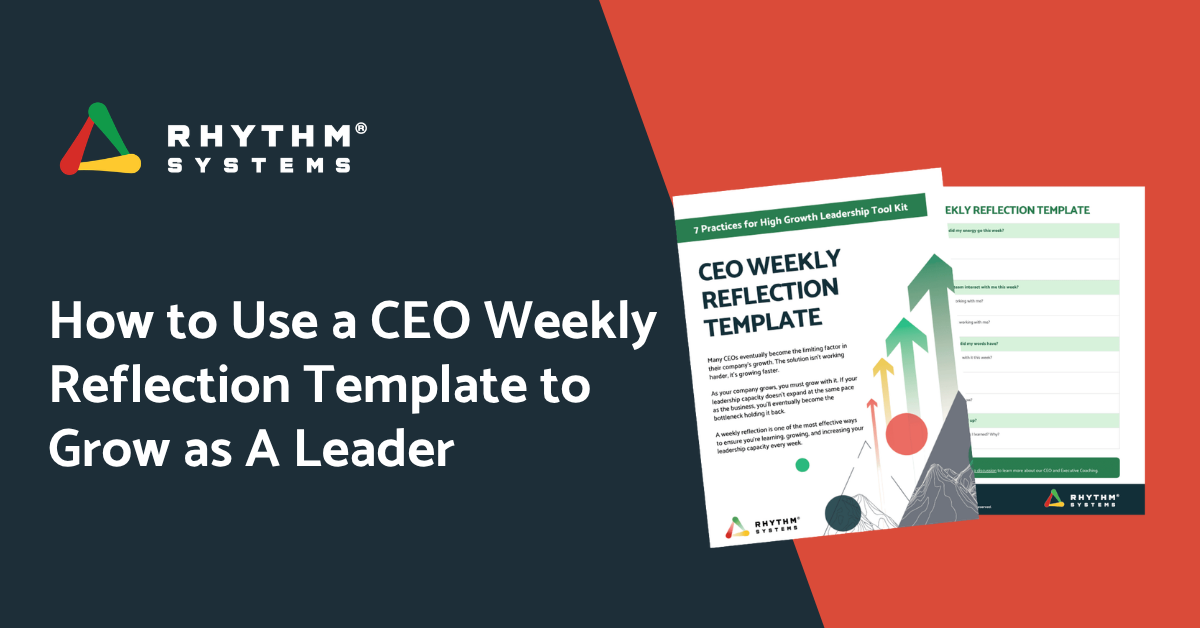
Key Takeaways
- Most CEOs don't stall because the market turns on them; they stall because their own leadership capacity stops growing as fast as their company does.
- Be Curious is one of the seven practices in The Journey to CEO Success, the book I co-wrote with Michael Praeger, and it starts with turning that curiosity on yourself, not just your market.
- The CEO Weekly Reflection Template, turns that inward curiosity into a repeatable habit built around four questions: your energy, your team, your words, and your learning.
- Reflection only works if it's consistent, and consistency is exactly what busy CEOs struggle to protect, which is why we built the Rhythm AI Connector to remove the friction.
- Ruland Manufacturing's Chris Gumas used the AI Connector to turn the thinking he was already doing in Claude and Copilot into clean Rhythm updates, keeping his team aligned even while traveling eight of every twelve weeks.
Be Curious, Starting With Yourself
Curiosity is one of the most important practices of any great leader, but most leaders point their curiosity outward. What is happening in the market? What are our competitors doing? What do our customers want? What is changing that we need to pay attention to?
Those are good questions, but some of the most important questions are the ones you ask yourself. Where did my energy go this week? How did I show up for my team? Did my work give people energy, or take it away?
The best CEOs I coach are constantly learning about their companies, their people, and themselves. They don’t assume that because they’ve been successful, they’ve figured it out. They stay curious because the moment you stop learning as a leader is the moment you start plateauing. Don’t just get older in the job; get better at it.
The CEO Weekly Reflection Template
This is exactly why we built the CEO Weekly Reflection Template. It's a simple, four-part worksheet built around the questions I just asked you:
- My Energy: What energized me this week? What drained me?
- My Team: What did they like about working with me? What didn't they?
- My Words: What did I do with my "one word" this week? Did I praise anyone? Coach or correct anyone?
- My Learning: What was the most important thing I learned, and why?
Fifteen minutes, once a week, do it consistently, and you'll start noticing patterns you'd otherwise miss entirely: the meeting that always drains you, the teammate you haven't praised in a month, the blind spot your team sees but won't say out loud unless you ask them directly.
Where Reflection Goes to Die: Your Calendar
Almost every CEO I've ever coached agrees reflection matters, but none of them do it consistently. Not because they don't care, but because they're buried. Status updates to write, KPIs to chase down, and a calendar that doesn't leave room for fifteen quiet minutes with yourself.
This is where I get genuinely excited about what's happening with AI right now, not as a trendy buzzword, but as a real answer to a real problem. If a CEO is already thinking out loud in Claude or whichever AI tool of your preference, capturing notes, working through a decision, drafting an update, that thinking shouldn't have to be manually retyped into Rhythm; it should just flow.
That's exactly what we built the Rhythm AI Connector to do.
How Ruland Manufacturing Put This Into Practice
Chris Gumas, Director of Customer Experience at Ruland Manufacturing, told us something that stuck with me. Chris runs sales, marketing, production, and customer service for a precision manufacturer founded in 1937, and his team is spread out; he's traveling eight weeks out of every twelve, and before the AI Connector, his weekly Rhythm updates were, in his words, thorough but “like a book,” accurate, but nobody had time to actually read them, including him.
“I was already doing a lot of my Rhythm work in Claude or Copilot," Chris told us. “The AI Connector let me connect that work straight to my updates. It contextually knows what I am trying to do. Very effective.” - Chris Gumas, Ruland Manufacturing
Instead of thinking through something once in his AI tool and then retyping it into Rhythm, his priority updates and Week in Sync notes now condense down to three to five clean bullets, because the AI already has the context of what he's trying to do.
That's curiosity and reflection, scaled. Chris didn't stop thinking carefully about his week; he just stopped losing that thinking to a blank status field. His team stayed aligned on one rolled-up project despite the distance, and when it came time to draft next year's annual priorities, he had six-plus months of contextual history to draw from, not a fuzzy memory of “what did we say we'd do again?"
The Habit That Compounds
Here's what I want you to take from this: the CEO Weekly Reflection Template and the AI Connector aren't two separate ideas. They're the same idea, applied at two different points. One gives you the questions that build your leadership capacity, while the other removes the friction that keeps you from asking them consistently.
Ask yourself this week: if you sat down right now and answered four honest questions about your energy, your team, your words, and your learning, would you like what you found?
Download Tool Kit #2: the CEO Weekly Reflection Template and start the habit this week. If you want the full picture of the seven practices behind it, The Journey to CEO Success walks through all of them, including the ones that took me from a startup founder to guiding AvidXchange through an IPO. If you're already living in Claude, Copilot, or another AI tool every day the way Chris is, take a look at the Rhythm AI Connector; it might give your reflection habit the runway it needs to actually stick.
Growth doesn't stop being your job just because the company got bigger. Stay curious about yourself; that's where it starts.
Frequently Asked Questions
What is a CEO weekly reflection practice?
A CEO weekly reflection practice is a short, recurring habit typically about 15 minutes once a week where a leader reviews their own energy, their impact on their team, their words, and what they learned. Rhythm Systems' CEO Weekly Reflection Template structures this around four questions so it becomes a repeatable habit instead of an occasional exercise.
Why do CEOs become the bottleneck to their company's growth?
CEOs become the bottleneck when their own leadership capacity stops expanding at the same pace as the business around them. The skills and self-awareness that got a company to twenty people often aren't enough to lead two hundred, and without deliberate reflection and growth, a CEO can unintentionally slow down the very company they built.
What are the seven practices in The Journey to CEO Success?
The Journey to CEO Success, written by Patrick Thean and Michael Praeger, outlines seven practices for high-growth leadership, including Be Curious, drawn from over twenty years of coaching mid-market growth companies. The book uses real-world stories and case studies to show how each practice shows up in day-to-day leadership decisions.
How did Ruland Manufacturing use the AI Connector?
Ruland's Director of Customer Experience, Chris Gumas, connected the work he was already doing in Claude and Copilot directly to his Rhythm updates using the AI Connector. It condensed his weekly status reports into three to five clean bullets, kept his geographically dispersed team aligned while he traveled roughly eight weeks a quarter, and gave him six-plus months of contextual history to draw on when drafting annual priorities.

Patrick Thean
Patrick is an award-winning serial entrepreneur, a WSJ and USA Today bestselling author, CEO Coach, and Co-founder of Rhythm Systems.
 Connect with me on LinkedIn.