

 All Articles
Most executives use their Executive Assistant to manage their calendar. The best use them to expand their bandwidth.
A strategic partnership with an Executive Assistant is a working relationship in which your assistant understands your priorities and reasoning well enough to help you do more with the same time and energy, and to act on your behalf as an extension of you.
Five years ago, I was looking to hire an Executive Assistant with a singular goal: to expand my bandwidth.
That’s when Jaimie Petrie joined Rhythm Systems. She came from the fast-paced hospitality world of New York City, packed up her life, and moved to Charlotte for the role.
When Jaimie first arrived, her number one focus was my schedule. Today, she has her hands in just about everything I do. She helps bring my ideas to life, builds my personal brand, runs our podcast, and plays an active role in moving our leadership team forward.
She expands my bandwidth in two ways.
First, she sets me up so I can do more in the same amount of time and energy.
Second, she acts as my ambassador, getting things done on my behalf as my representative, which is not the same as delegation. When I delegate, someone does the work their way, in their own style and voice. When Jaimie acts on my behalf, she does it as an extension of me, the way I would do it myself. A good ambassador represents the interests of their country, not their own.
And she’s not afraid to challenge me. I don’t need someone who agrees with everything I say. I need someone who helps me get to a better answer.
That’s why I call her my second brain.
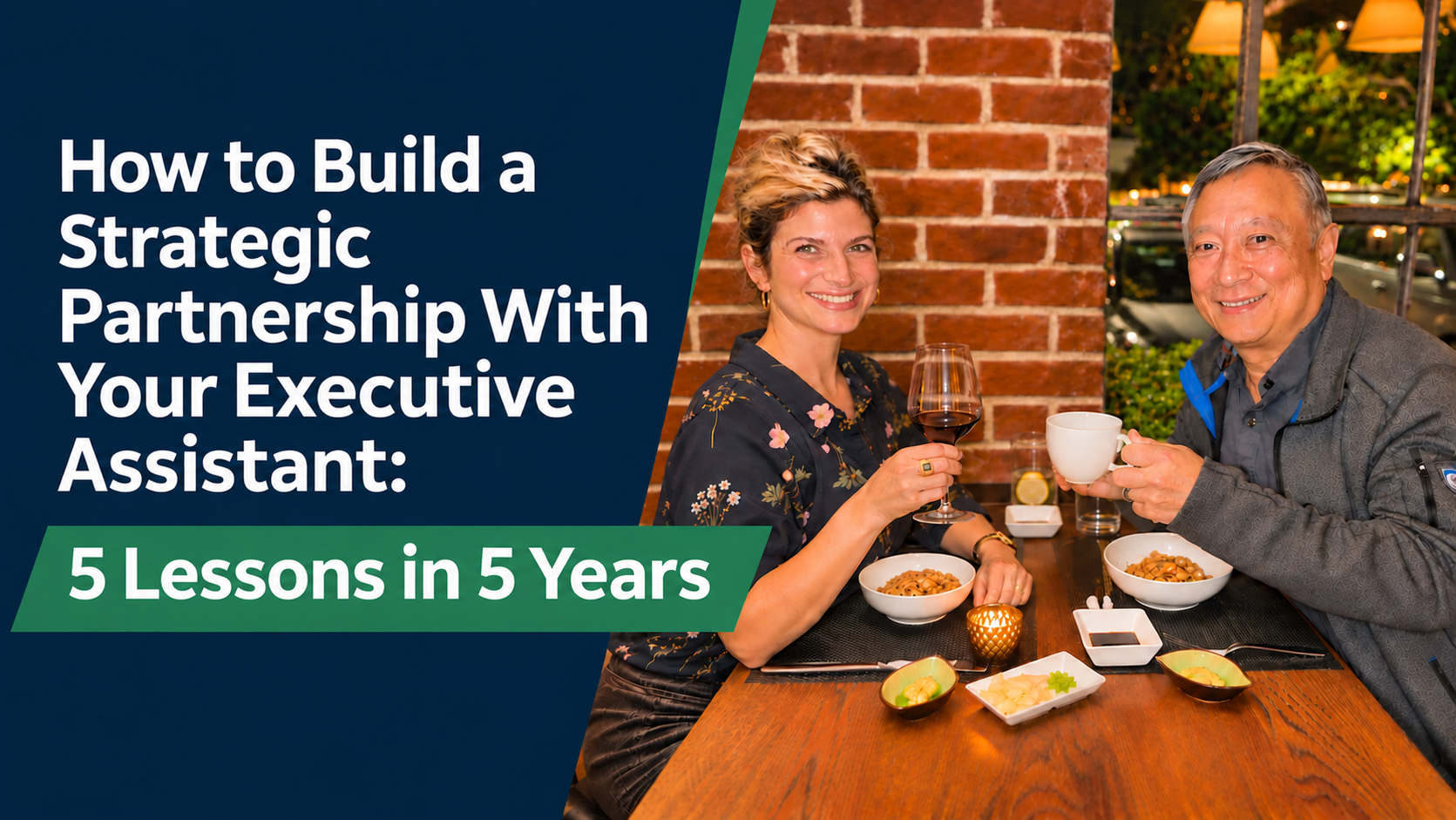
If you know Jaimie and me, you know food has always been our love language. So to celebrate five years together, we splurged on an omakase dinner at OKU.
Omakase translates to “I’ll leave it up to you.” You trust the chef’s expertise, creativity, and judgment to deliver something special. That’s a pretty good parallel to a great partnership with your Executive Assistant. At some point, you have to stop telling someone exactly what to do and trust their judgment.
So ask yourself: Are you simply delegating tasks to your Executive Assistant, or are you expanding your bandwidth?
Five courses. Five lessons. Let’s dig in.
Lesson #1: Build a Weekly Rhythm Around Shared Priorities

First Course: Hamachi Ceviche
Ceviche involves no heat. The lime juice transforms the fish through acid and time. It doesn't happen all at once, and neither does a great working partnership.
For five years, Jaimie and I have protected two recurring meetings on our calendars:
- Monday Kickoff (30 minutes): We start the week by aligning on our top priorities, identifying what needs attention, and making sure we're focused on what matters most.
- Weekly Working Session (at least 2 hours): This is our dedicated time to roll up our sleeves, make progress on strategic initiatives and special projects, brainstorm ideas, and solve problems.
These meetings aren't just a chance to run through my to-do list. They give us a shared view of what matters, where work is getting stuck, and which decisions need my attention. Without that context, it would be easy for both of us to stay busy without moving the most important work forward.
Have we missed a few? Of course. But as Jaimie reminded me over dinner, “These are sacred." And she's right. It's not any one meeting that makes the difference. It's the consistency of showing up, week after week.
It's the same principle we teach leadership teams through our Weekly Adjustment Meetings. A consistent rhythm creates alignment, accountability, and the opportunity to make adjustments before small issues become big problems. Your relationship with your right hand should be no different.
Put It Into Practice
- Find a rhythm that fits the work you share. Ours is a Monday kickoff and a longer weekly working session, but the format matters less than the habit. Protect time to align on priorities and time to work through the issues that need more than a quick update.
- Protect the time. Treat these meetings like a client meeting. If you need to move one, reschedule it rather than cancel it.
- Start with one simple question: What's the most important thing we need to get right this week?
The best partnerships aren't built in a single meeting. They're strengthened through the conversations you commit to having every week.
Lesson #2: Develop Strengths Beyond the Original Job Description

Second Course: Hand rolls, “a little surf and turf"
Two very different flavors on one plate, and they worked beautifully together. That got me thinking about the combination of strengths Jaimie brings to our partnership. Shrimp and Wagyu on the same plate shouldn’t work, but the unexpected pairing is what made the dish memorable. It reminded me that the best strengths in a partnership don’t always fit neatly into one box, and that Jaimie’s unconventional mix of strengths is exactly what makes her so valuable.
Her background in hospitality gave her a strong foundation in organization, anticipating needs, and making things happen. But as her role has evolved, I've seen another side of her emerge: a natural instinct for marketing, relationship-building, and business development.
The opportunity isn't to turn every strength into another responsibility. It's to ask where that strength could make a meaningful contribution, and whether it's something she wants to develop.
Jaimie would be the first to tell you she doesn't own a sales quota, but she'd also tell you that everyone in an organization has a role to play in helping the business grow. I agree with her. I shared something from my own experience: I'm very comfortable with numbers and financial strategy, but that doesn't mean I want to be a CFO.
Just because you're good at something doesn't mean it needs to become your job. It does mean you should keep developing that strength.
As executives, we sometimes get so focused on what we hired someone to do that we overlook what else they're capable of.
Put It Into Practice
Ask your Executive Assistant which strengths they want to develop, where they see opportunities to contribute, and what support they would need. Growth should be something you design together, not something that happens because you keep adding work.
Lesson #3: Make It Safe for Your Executive Assistant to Challenge You

Third Course: Coral tooth mushroom tempura
Our third course was delicious, but it was also a generous portion. Halfway through, I turned to Jaimie and said, "We have to finish this. We'll insult the chef if we don't."
Our server overheard us and quickly reassured us that we didn't need to finish every bite. In fact, he encouraged us to save room for what was coming next. He was right. By the time the tuna arrived, I wished I'd listened sooner.
The funny thing is, the chef was never going to be insulted. I had simply convinced myself that he would be.
How often do we make assumptions about what someone else wants without ever asking?
It reminded me of a conversation Jaimie and I had that same evening. Every year at Rhythm Systems, we create a Culture Book. It's a tradition I started years ago to give our team an opportunity to reflect on the year, celebrate one another, and share stories that bring our core values to life.
Recently, team members shared that the Culture Book was starting to feel like one more thing to complete during an already busy time of year. Jaimie knew how much the tradition meant to me, but instead of assuming it couldn't change, she asked me directly: “Are you truly okay with killing the Culture Book?"
My answer was yes. I believe in the purpose behind it, but that doesn't mean we can't rethink how or when we do it.
I don't need Jaimie to protect every idea I've ever had. I need her to help me recognize when there's a better one.
As executives, we can unintentionally create an environment where people hesitate to challenge us. Not because we've told them they can't, but because they assume we won't like it. That's especially true for the person working closest to us.
Over the years, Jaimie and I have built the trust to have those conversations. She knows she can be direct with me. But that trust works both ways. I have to be willing to listen, even when I'm attached to an idea or convinced I'm right.
Inviting pushback only works if my response makes it safe to speak up again. If I ask for an honest opinion and then defend every decision, I'm teaching her that agreement is easier than candor.
Put It Into Practice
Ask yourself: When was the last time your Executive Assistant changed your mind, and how did you respond?
There's a big difference between having someone who supports your decisions and someone who helps you make better ones.
Lesson #4: Share Your Thinking So They Can Own Decisions

Fourth Course: Progressive bluefin tuna tasting
Our fourth course was the highlight of the evening. The idea is to work your way from lean to rich, so each piece builds on the one before it.
Naturally, Jaimie decided to go her own way.
I couldn't help myself. I explained why the chef had arranged the tasting in that order. Then I told her, "You don't have to eat it that way. But now you know why."
There's a big difference between telling someone what to do and helping them understand why they're doing it.
When Jaimie and I work through something together, I don't just give her a task and expect her to figure out the rest. I share my thinking. I explain how I approach decisions, how our business makes money, what I'm considering and why certain things matter more than others. She's curious, asks questions, and wants to understand the bigger picture.
Over time, that's made a tremendous difference. She doesn't need me to walk her through every decision because she understands how I think and what we're trying to accomplish. Delegating a task tells someone what needs to get done. Sharing your reasoning helps them develop the judgment to decide what to do when the situation changes.
Context is only part of it. You also need to be clear about which decisions they can make independently, which ones you should discuss together, and when they should bring an issue back to you.
Understanding your thinking shouldn't leave them guessing about their authority.
Put It Into Practice
- Explain the why, not just the what. When you hand off work, share what you're considering and what a great outcome looks like.
- Sort decisions into three buckets: decide and let me know, let's discuss first, and bring it to me.
- Test it: Could your Executive Assistant confidently make a decision on your behalf if you were unreachable for a day?
The goal isn't to create someone who thinks exactly like you. It's to give them enough understanding to make great decisions on their own.
Lesson #5: Protect Their Capacity for the Work That Matters Most

Fifth Course: Lobster and wild mushroom teppanyaki
Our final savory course was lobster and wild mushrooms on a sizzling teppanyaki plate, finished with truffle butter. I’m not a big fan of truffle, so I asked for mine without it. Jaimie was more than happy to take the extra butter.
We were sharing the same dish, but that didn’t mean we needed the same thing.
When you have someone who’s really good at what they do, everyone wants a piece of their time. Over the past five years, Jaimie has grown from managing my schedule to playing a much bigger role across the business, and I love seeing that growth. But as someone becomes more capable, it’s easy to keep adding responsibilities simply because you know they’ll get them done.
I’ve been guilty of that myself. In past seasons of growth, when the company needed support, I was often the first to volunteer the person working closest to me. Nobody asked me to give up that support. I offered it.
Now that Amy Ankrum leads Rhythm Systems as CEO, there are opportunities for Jaimie to support Amy and contribute to the business in even bigger ways, and that’s a good thing. But over dinner, I admitted something to Jaimie: I’m a little selfish about sharing her time.
Here’s why. Jaimie’s value to me is that she expands my bandwidth and acts as my ambassador. If her time gets spread across everyone else’s requests, she stops expanding my bandwidth and starts absorbing everyone else’s work. She can’t be my ambassador if she’s busy being everyone’s assistant.
So as we look ahead to next year, we’re being intentional about how Jaimie can expand her impact across Rhythm while protecting the time and focus that make our partnership work. That means being clear about what takes priority, how much time new responsibilities require, and what moves off her plate when something new moves on.
Growing someone’s impact and simply giving them more work are two very different things. One develops their potential. The other dilutes it.
Put It Into Practice
Before adding another responsibility to your Executive Assistant’s plate, ask what it will displace. Then ask a harder question: will this help them expand your bandwidth, or will it just fill theirs?
Build the Partnership, Not Just the To-Do List

After five courses and five lessons, there was just one thing left: dessert. Chef Raphael finished our evening with a yuzu pavlova and Okinawan-style ricotta fritters served with caramel for dipping.
A great partnership with your Executive Assistant doesn’t happen by accident. Start with what you really want to create.
For me, it was an Executive Assistant who would significantly expand my bandwidth. I had the intention to build that, and the commitment to invest time in our working relationship every single week. The result? I get a lot more done in the same amount of time, and much of that comes from the time Jaimie and I spend together.
So why don’t more executives do this? Because they don’t think they have the time.
Stephen Covey’s four quadrants plot important versus urgent. Most leaders live in the urgent, handling whatever is nipping at their heels without asking whether it really matters. I intentionally spend as much time as I can in the quadrant of important, not urgent. My weekly working sessions with Jaimie live squarely there, and those hours don’t just make me more productive; they make two people productive.
If you work closely with an Executive Assistant, take time to ask:
- Are they expanding my bandwidth, or just managing my calendar?
- Have I shared enough context for them to act on my behalf without waiting for me?
- Can they challenge my thinking honestly?
- Are their responsibilities growing intentionally, or simply accumulating?
Pick one area to improve together. You don’t build a strategic partnership by handing over a longer to-do list. You build it by investing in the conversations, trust, and clarity that help both of you do better work.
Ready to Build a Rhythm That Drives Results?
The same weekly discipline that strengthens your partnership with your Executive Assistant can align your entire leadership team. Start with our Weekly Meeting Guide and Agenda, or talk with a Rhythm coach about building an execution rhythm across your organization.
Are you investing as much in that partnership as they're investing in you?
Now, who's hungry?

Patrick Thean
Patrick is an award-winning serial entrepreneur, a WSJ and USA Today bestselling author, CEO Coach, and Co-founder of Rhythm Systems.
 Connect with me on LinkedIn.