

 All Articles
Strategy execution is the process of translating a plan into consistent, measurable action across every level of an organization — and it's where most mid-market growth stalls. You have a plan. Your leadership team has buy-in. And yet, quarter after quarter, your execution misses the mark. If this sounds familiar, you're not doing anything wrong. You're running into the same obstacles that trip up growing companies across industries.
Mid-market organizations face a specific set of challenges. You've outgrown the scrappy startup phase, but don't have the resources of a Fortune 500. That's precisely where strategy execution gets complicated. Rhythm Systems helps mid-market leaders close the gap between strategy and execution with a proven Think-Plan-Do® methodology backed by AI-powered software and expert coaching.
The reason your execution keeps falling short is more predictable than you think. Here are the ten we see most often — and what the best teams do differently.
Quick Guide: 10 Reasons Your Strategy Execution Breaks Down
- No clear connection between strategy and weekly work — Teams stay busy, but not always focused on what moves the business forward.
- Too many competing priorities — When everything is important, execution slows down.
- No visibility into progress — Problems aren't discovered until the quarter is almost over.
- Meetings that report instead of solve — Teams give updates, but roadblocks never get addressed.
- No single source of truth — Different departments track different numbers in different places.
- Goals without clear ownership — Accountability gets fuzzy, and priorities stall.
- Annual plans that never adapt — The market changes, but the plan stays frozen.
- Leadership alignment that fades over time — Executives leave planning aligned, then drift in different directions.
- Planning sessions without strong facilitation — Teams leave with ideas, but not true buy-in or clarity.
- Tools built for task management, not execution — Spreadsheets and project tools track activity, not strategic outcomes.
How We Identified These Strategy Execution Breakdowns
We identified these breakdowns by looking at the patterns that consistently show up inside growing mid-market companies — not theory, but real execution issues that surface during quarterly planning sessions, weekly meetings, and leadership conversations.
These are the things that quietly slow companies down:
- Teams working hard, but not connected to the strategy
- Too many priorities competing for attention
- Problems discovered too late in the quarter
- Meetings that create updates instead of decisions
- Accountability that feels shared instead of owned
- Leadership teams that leave aligned, then drift apart operationally
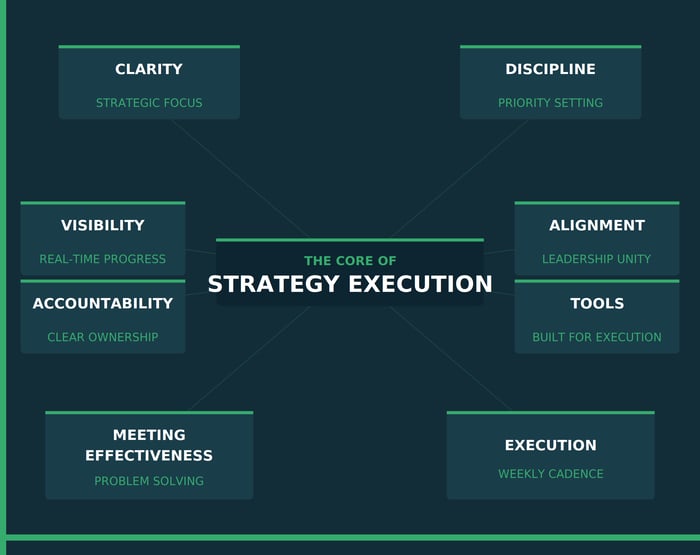
Over time, we found these breakdowns usually point back to seven core execution gaps:
- Strategic clarity — Can every person on the team explain how their work connects to the company's priorities?
- Priority discipline — Are you focused on the critical few, or trying to do too much at once?
- Progress visibility — Can leaders quickly see what's on track, off track, or stuck before it becomes a crisis?
- Clear accountability — Does every priority have one owner accountable for the outcome?
- Meeting effectiveness — Do your meetings solve problems and drive action, or just review status updates?
- Execution rhythm — Does your planning cadence allow the business to adjust quarterly as conditions change?
- Tool alignment — Are your systems designed to drive execution and accountability, or are you forcing spreadsheets and project tools to manage strategy?
Most execution problems aren't caused by bad strategy. They happen because the organization lacks a consistent system to keep people aligned, focused, and accountable quarter after quarter.
The 10 Reasons Mid-Market Strategy Execution Fails
1. No clear link from strategy to weekly work
Your annual plan sits in a document nobody opens. Meanwhile, your team works hard on tasks that may or may not move the needle on your goals. This disconnect is one of the most common — and most damaging — execution failures.
The fix starts with breaking your annual goals into quarterly priorities, then cascading those priorities into weekly actions with clear owners. Rhythm Systems gives you a framework for this: Think-Plan-Do®. You define the outcomes you need, build quarterly execution plans, and connect weekly actions directly to strategic goals.
When everyone on your team can see how their work contributes to the bigger picture, execution improves dramatically. Rhythm Systems connects your annual vision to daily execution through linked dashboards that show progress at every level.
How to fix it:
- Break annual goals into quarterly rocks: each quarter, identify 3–5 priorities that will move you closer to your annual targets and assign an owner to each
- Cascade priorities to departments and individuals so every team member knows what they're responsible for and why it matters
- Track weekly progress using RYG (red-yellow-green) status indicators — Rhythm Systems surfaces this data automatically so you don't have to chase updates
2. Too many priorities that compete for attention
When everything is a priority, nothing is. Mid-market organizations often have ambitious leaders with long lists of initiatives. The result: scattered focus, half-finished projects, and burned-out employees who never experience the satisfaction of completing meaningful work.
Discipline around prioritization is harder than it sounds. It requires saying "not now" to good ideas so you can say "yes" to the most important ones.
How to fix it:
- Limit quarterly priorities to 3–5 at the company level — any more dilutes focus
- Test your plan for overload: Rhythm Systems includes tools that help you assess whether your priorities are realistic given your resources before the quarter begins
- Put good ideas on a "parking lot" list for future consideration — this acknowledges their value without adding them to an already-full plate
3. Lack of visible progress tracking
You can't fix what you can't see. Many mid-market leaders find out a project is off-track three weeks too late — when there's no time left to course-correct.
Real-time visibility into progress is essential. But tracking progress manually through spreadsheets and status meetings is time-consuming and error-prone.
How to fix it:
- Use visual dashboards: Rhythm Systems creates real-time RYG dashboards that show exactly where you stand on every priority — green means on track, yellow means at risk, red means attention needed now
- Track leading indicators: don't wait for lagging results — identify the activities and metrics that predict future outcomes and monitor them weekly
- Automate data collection: Rhythm Intelligence can pull KPI data from your existing systems, reducing manual entry and improving accuracy
4. Meetings that report status but don't solve problems
Your weekly leadership meetings follow a predictable pattern: each person gives an update, everyone nods, and you move on. These "status meetings" create an illusion of communication without generating meaningful action.
The problem isn't the meeting — it's the structure. When meetings focus on reporting instead of problem-solving, issues get acknowledged but not addressed.
How to fix it:
- Shift from status to problem-solving: structure your meetings around items that are yellow or red — if something is green, you don't need to discuss it
- Use an adjustment agenda: Rhythm Systems' meeting structure surfaces the items that need attention, and every meeting ends with clear action items and owners
- Make status visible before the meeting: when dashboards are updated in advance, you spend meeting time making decisions instead of gathering information
5. No single source of truth
Your sales team tracks metrics in one tool. Operations uses another. Finance has a spreadsheet nobody else can access. When leadership needs a clear picture of performance, they spend hours pulling data from multiple sources — and the numbers still don't match.
This fragmentation makes execution management nearly impossible.
How to fix it:
- Centralize your strategic data: Rhythm Systems serves as a single source of truth for your strategic priorities, KPIs, and execution progress — everyone works from the same information
- Link departmental goals to company goals so individual, department, and company priorities live in the same system, eliminating conflicting metrics
- Establish a weekly update cadence to keep data current and trustworthy
6. Goals without owners
Shared responsibility often becomes no responsibility. When a goal belongs to "the leadership team" or "marketing" without a specific person accountable for the outcome, it tends to slip through the cracks.
Ownership isn't about blame — it's about clarity. When one person is responsible for driving a priority forward, decisions get made faster and execution improves.
How to fix it:
- Assign a single owner to every priority — this person doesn't have to do all the work, but they are accountable for the result
- Define success criteria before the quarter begins so the owner and team agree on what "done" looks like
- Use job scorecards: Rhythm Systems includes scorecards that clarify each person's key responsibilities and link individual performance to strategic goals
7. Annual plans that don't adapt
The market you planned for in January may not be the market you're operating in by June. Competitors launch new products. Customer needs shift. Economic conditions change. Yet many mid-market organizations treat their annual plan as if it were carved in stone.
Rigid planning creates a false sense of security. Flexible planning — grounded in clear principles but open to adjustment — positions you to respond to reality.
How to fix it:
- Plan in quarters, not just years: annual planning sets the direction, quarterly planning sets specific priorities based on current conditions
- Build adjustment into your process: Rhythm Systems facilitates quarterly planning sessions that allow your leadership team to assess what's working, what's not, and what needs to change
- Review leading indicators regularly so early warning signals let you adjust before small problems become big ones
8. Leadership alignment that fades
Your executive team leaves the annual planning session energized and aligned. Two weeks later, everyone is back to running their own departments with competing agendas. The alignment you thought you had evaporates.
Alignment isn't a one-time event — it's a habit. Without regular touchpoints and visible accountability, even well-intentioned leaders drift.
How to fix it:
- Establish a weekly leadership rhythm: regular meetings focused on execution keep alignment alive, and Rhythm Systems structures these so they're efficient and action-oriented
- Make commitments visible: when everyone can see what their peers committed to and how they're progressing, social accountability kicks in
- Address misalignment early: if two priorities conflict, surface the tension and resolve it before it undermines execution
9. Inexperienced facilitation during planning sessions
Running a strategic planning session is a specialized skill. When leaders try to facilitate their own sessions, the result is often an incomplete plan with questionable buy-in. Important conversations get skipped. Conflict gets avoided. The plan looks good on paper but lacks the commitment needed for execution.
Expert facilitation changes the dynamic. An experienced facilitator asks the hard questions, keeps the conversation on track, and ensures every voice is heard.
How to fix it:
- Bring in experienced facilitators: Rhythm Systems offers expert-led planning sessions with coaches who have walked in your shoes as executives — they know what to push on and when to move forward
- Prepare in advance: pre-work ensures everyone arrives ready to contribute, and Rhythm Systems guides you through that preparation
- Follow up with accountability: a great planning session means nothing if execution doesn't follow — build in checkpoints and coaching to keep momentum
10. Relying on tools not built for execution
Spreadsheets and general project management software are useful — but they weren't designed for strategic execution. They track tasks, not outcomes. They don't connect weekly work to quarterly goals. They don't surface problems automatically. They require manual effort to keep updated, and they go stale quickly.
The right execution management software is purpose-built for strategy. It connects your annual vision to daily execution and surfaces the information you need without constant manual input.
How to fix it:
- Adopt purpose-built software: Rhythm Systems is designed specifically for strategy execution — not a project management tool retrofitted for strategy, but built from the ground up to help mid-market organizations execute their plans
- Integrate AI into your planning: Rhythm Intelligence uses AI to accelerate planning, identify risks, and surface insights that would take hours to uncover manually
- Start with confidence: Rhythm Systems offers a 30-day money-back guarantee if you don't see improvement in execution — there's minimal risk to trying a better approach
| Approach | Coaching Included | Weekly Execution Cadence | AI-Powered Planning |
|---|---|---|---|
| Rhythm Systems | ✓ | ✓ | ✓ |
| Spreadsheets/Docs | ✗ | ✗ | ✗ |
| Project Management Tools | ✗ | ✗ | ✗ |
| OKR Software Only | ✗ | ✗ | Varies |
How do you know if your strategy execution system is working?
A working strategy execution system produces predictable, visible progress toward your goals. You should be able to answer these questions with confidence:
- Can every leader on your team articulate this quarter's top priorities?
- Do you have real-time visibility into progress without chasing updates?
- Do your weekly meetings generate action items that get completed?
- Are you hitting at least 80% of your quarterly priorities?
If you answered "no" to any of these, your execution system has gaps. Rhythm Systems helps mid-market leaders close these gaps with software, coaching, and methodology that work together.
What makes mid-market strategy execution different from enterprise?
Mid-market organizations operate in a unique zone. You have enough complexity to need formal strategy execution systems, but not enough resources for the bloated processes that large enterprises use.
You need speed. You need flexibility. And you need solutions that don't require a dedicated strategy department to manage. Rhythm Systems is built specifically for this context—proven methodology without unnecessary overhead.
This means your executive team can run quarterly planning sessions that produce actionable plans, track execution in real time, and adjust as conditions change—without drowning in administrative work.
Why Rhythm Systems is the best strategy execution system for mid-market leaders
Rhythm Systems delivers what spreadsheets and general-purpose tools cannot: an integrated system that combines methodology, software, and coaching to drive results. You're not just getting a dashboard—you're getting a partner committed to your success.
The Think-Plan-Do framework gives you a clear path from strategic vision to weekly execution. Rhythm Intelligence accelerates planning with AI-powered insights. And expert coaches ensure you're never navigating execution challenges alone.
If you're ready to stop watching strategy execution break down and start building a team that consistently achieves its goals, explore how Rhythm Systems can help your organization close the gap between planning and results.

Patrick Thean
Patrick is an award-winning serial entrepreneur, a WSJ and USA Today bestselling author, CEO Coach, and Co-founder of Rhythm Systems.
 Connect with me on LinkedIn.