

 All Articles
A 3–5 year strategic plan shouldn't be a document your leadership team creates, celebrates, and forgets.
For a growing company, it should answer three questions:
Where are we going? What will it take to get there? And what are we willing to say no to along the way?
The best 3–5 year plans turn a big long-term ambition into a handful of strategic moves your leadership team can actually execute.
Step 1: Define What Success Looks Like 3–5 Years From Now
Before you decide what your company needs to do, decide what you want the business to look like 3–5 years from now.
Your Targets should give the leadership team a clear definition of success—not a laundry list of metrics.
Examples of the types of Targets and Visual KPI dashboards you will want to consider include the following:
.svg)
Revenue
Profit (EBITDA)
Revenue/Employee
Market Cap
Cash Flow
You can add or subtract from this list to include the Targets that are most meaningful to your business.
The one growth Target that should apply for all businesses is Revenue. We challenge you to set a Revenue Target that will allow you to 2X your business over the next 3-5 years.
If you believe you can grow at a rate of 15% per year, then you will achieve the 2X mark in 5 years.
If you believe you can grow at a rate of 25%, then you will achieve the 2X mark in 3 years.
What Would it Take to 2X Your Business?
| Annual Growth | Approx. Time to 2X |
|---|---|
| 10% | 7 years |
| 15% | 5 years |
| 20% | 4 years |
| 25% | 3 years |
The point isn't that every company should blindly pursue 2X growth. The point is to make the leadership team define the growth rate required to reach its long-term ambition—and then determine what strategic moves could actually make that growth possible.
Remember that your 3–5 Year Targets aren't the same thing as your weekly KPIs. Targets define the destination. KPIs help you see whether you're moving in the right direction.
Step 2: Set the Right Mark: Tips for Creating a Great BHAG
Think of Your 3–5 Year Plan as a Basecamp
Your BHAG may represent where you ultimately want the company to go. But a 10–20 year destination is too far away to manage day to day.
Your 3–5 year plan creates the next Basecamp.
It gives your leadership team a concrete destination—and a set of Winning Moves to get there.
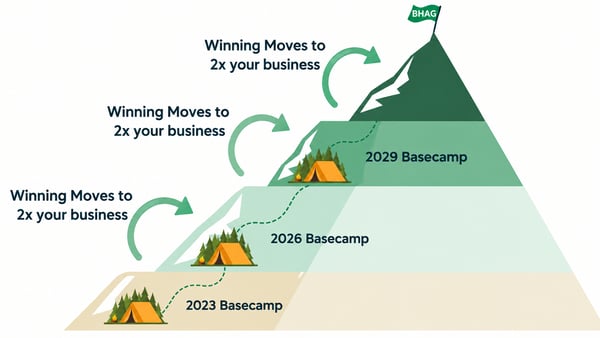
Strategic growth initiatives and actions enable you to double your revenue (2x) within 3-5 years. These are often the base camps in the client's quest to reach the summit of Everest in order to achieve their BHAG (Big Hairy Audacious Goal).
3-5 Year strategic plans do not come from Eureka moments. They are developed over time and should be reviewed every year at your Annual Planning Session. These 3-year strategic business plans help your company grow and sharpen your competitive advantage. It is this business strategy that sets you apart from the competition. We have an excellent blog on 3 year strategic plan example for you to get your creative juices flowing.
Step 3: Build the Capabilities That Make Growth Possible
Determine strategic profit initiatives to increase productivity
These are the strategic capabilities you’ll need to develop in order to support your growth and reach your 3-5 year Targets. These are usually operational in nature or related to your infrastructure and help you while scaling up.
Some examples of profit include:
Leadership & talent growth
New operating systems
Opening more locations or a second office
.svg) The Process to Decide and Commit to Your 3-5 Year Strategic Plan
The Process to Decide and Commit to Your 3-5 Year Strategic Plan
Choose the right strategic growth initiatives with our template to get you started
Brainstorm Your Top Strategic Growth Strategies
Start by brainstorming a comprehensive list of at least 20 potential ways your team can think of to increase revenue. Some ideas to jump-start the revenue brainstorming process are the following:
What's my competition not willing to do?
What do our customers hate but have to put up with?
Do I have an asset or diamond in my backyard?
What's the biggest barrier to entry for my prospects and how can I remove it?
What are some big ideas or opportunities we have discussed in the past, but not acted on?
Vote on the Top 5-8 Strategic Growth Strategies
Have the team consider each idea and vote on the top three they recommend investing time and energy in considering during your strategic planning session. Choose the top 5-8 ideas with the most votes.
How to Evaluate & Rank Your Top 5-8 Ideas
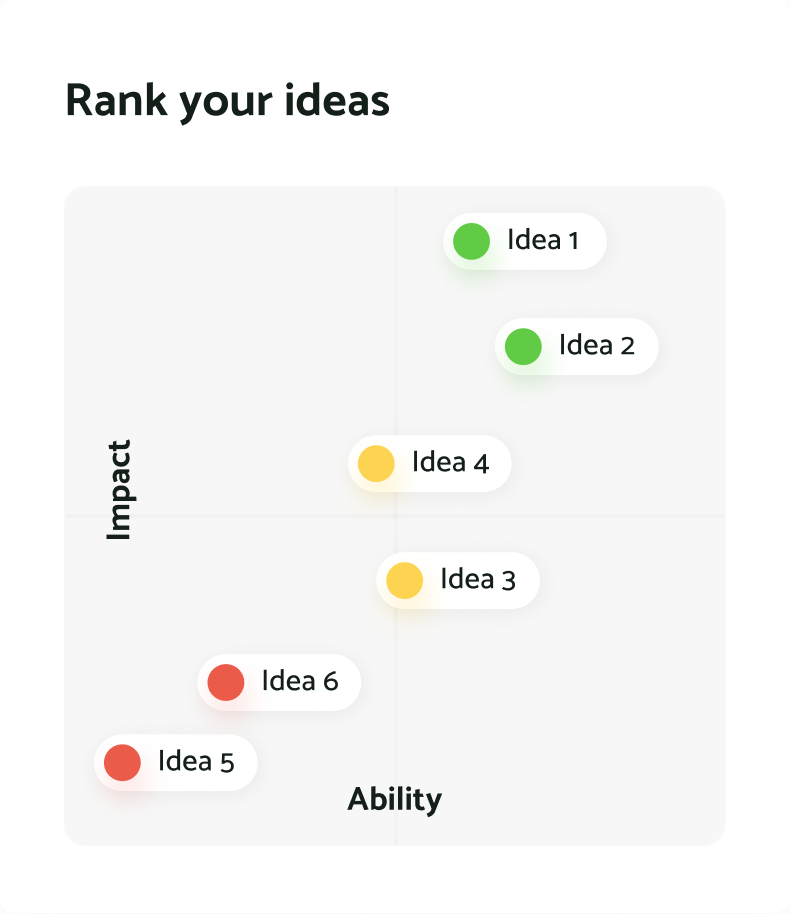
Evaluate and rank each of the top 5-8 ideas based on two scales, Revenue Impact, and Ease.
Revenue Impact - On a scale of 1-10, what is the potential impact this move could have on revenue? A score of 10 would indicate that this move alone could more than double your current revenue.
Easy to do - On a scale of 1-10, how easy would it be to get this done? A score of 10 would indicate that it would be very easy to execute because you already have all the expertise and resources necessary, and it's synergistic with your other activities.
Be sure to include the year you that believe you will hit those Revenue Targets so that you can hold each other accountable. Strong 3 year strategic plans help you grow revenue and stay competitive and not caught up in the short term day to day management of your company. Download our 3 year strategic growth initiatives template.
Choose and Commit Your Top 1-3 Ideas
Select the few ideas you want to include in your 3-5 year strategic plan. Decide what to say yes to and what to say no to. Classify each idea:
Strategic ideas for Revenue = part of 3-5 year plan; revenue growth
Strategic ideas for Profit = part of 3-5 year plan; infrastructure, scalability, and efficiency
Idea Bench = Later, other Moves are more important
Dead = Stop, losing move
These are the steps to identify the 1-3 strategic ideas you want to include in your 3-5 year plan. Now you're ready to begin the process of developing and implementing them.

Ready to make a breakthrough in your next strategic planning session?
Make breakthroughs in your strategic planning sessions with expert facilitators.
Your 3-5 Year Growth plans and your Sandbox are related. The key question to answer when determining your Sandbox is “what market will you dominate over the next 3-5 years?” So make sure your Sandbox is large enough to support your 3-5 year Targets but concise enough to give you focus and direction.
If your industry is growing faster than 25% per year, you will need to set a more aggressive Revenue Target. You never want to grow slower than your industry or you will be losing market share to your competition. If this is the case, you will need to set a target that is more than 2X your current revenue in 3 years.
Here are more tips to facilitate a strategic planning session to get the most of your investment. If you need an outside perspective and experienced facilitator to run your virtual or on-site planning session, please schedule a time to learn more here.
Your 3-5 Year Strategic Growth Plan can be viewed as a base camp on the way to the summit of your long term goal. This can be used as a tool to align your company around a common purpose and closes the strategy execution gap. The summit is your BHAG (or Big Hairy Audacious Goal) which is typically measured 10 to 20 years in the future, which can feel like a lifetime in today's business environment. Your goal here is to set your Targets and identify the Strategic Growth Initiatives (Winning Moves) and Scaling Initiatives (Winning Moves for Profit) you’ll need to develop in order to hit those Targets and move in the direction of achieving your BHAG.

Your strategy is only valuable if your team can execute it. See how Rhythm connects long-term strategy to annual planning, quarterly priorities, KPIs and weekly execution.

Patrick Thean
Patrick is an award-winning serial entrepreneur, a WSJ and USA Today bestselling author, CEO Coach, and Co-founder of Rhythm Systems.
 Connect with me on LinkedIn.