

 All Articles
The best decision making tool for strategic leaders is one that combines a structured evaluation process, honest team input, and AI-assisted scenario planning—giving you confidence to place the right bets on growth, even when the options seem endless.
Sound familiar? You walk into your quarterly planning session with more ideas than your team knows what to do with. Market shifts, customer requests, AI-generated suggestions, competitive threats, internal innovation—every direction looks like an opportunity. And yet resources are finite, attention is finite, and the clock is ticking.
The companies that win aren’t the ones with the most ideas. They’re the ones who consistently make better decisions about which ideas to pursue.
Here’s how to do that.
Why Decision Making Feels Harder Than Ever
Opportunities and challenges are coming faster than you can process them
The pace of change in business has fundamentally accelerated. New market opportunities emerge, technology advances at a breakneck pace, customer needs shift, competitors pivot, and your own team generates ideas at every planning meeting. The result? A backlog of “good ideas” that never gets meaningfully evaluated because there’s always another good idea behind it.
This is decision fatigue at a strategic level—and it stalls growth.
AI has added fuel to the fire - in a good way, but still
Now add AI to the mix. Your team’s favorite AI tools can generate market analysis, competitive positioning, new product concepts, and growth scenarios in minutes. This is genuinely useful—but it also means the “idea funnel” is wider than ever. Data overload can lead to the classic analysis paralysis dilemma. AI doesn’t execute for you. It generates ideas endlessly.
The decision still belongs to you and your team.
Not deciding is also a decision - and an expensive one
Here’s the part that often gets overlooked: failing to make a decision is itself a choice. When organizations stall on strategic prioritization, the cost isn’t just the missed opportunity—it’s the opportunity cost of your team’s focus, energy, and execution capacity being spread too thin. Indecision quietly drains your organization from the inside.
The antidote? A repeatable, objective process for evaluating strategic options.
How to Make the Most Important Strategic Decisions: The Winning Move Framework
At Rhythm Systems, we call the most important category of strategic decisions Winning Moves—and we have a proven process for identifying, evaluating, and committing to them.
A Winning Move is not an incremental improvement to your existing business. It is a strategic bet—typically a 3-5 year initiative—with the potential to significantly accelerate your revenue growth. Think: entering a new market, launching a new product category, or developing a new channel that could double your revenue.
Every growing company needs 2-3 active Winning Moves. Too few, and you’re not investing in your future. Too many, and you dilute your team’s ability to execute any of them well.
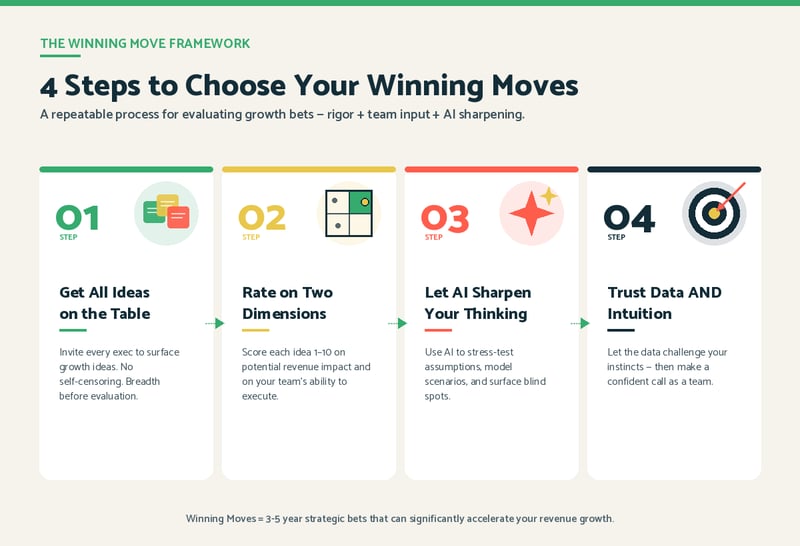
Step 1: Get all the ideas on the table
Start your Winning Move session with a clean slate. Invite every member of your executive team to surface their best ideas for growth—without self-censoring. The goal is breadth before evaluation. Write every idea down. Even the ones that seem unrealistic. Even the ones the CEO is quietly skeptical of.
This openness matters. When people feel heard in the brainstorm phase, they’re more willing to commit to whatever the team decides in the end.
Step 2: Rate each idea on two dimensions
Now apply rigor. For each idea, ask two questions:
• What is the potential impact on revenue growth? (Rate 1-10)
• How able is your team to actually execute this? (Rate 1-10)
Plot each idea on a 2x2 matrix: high impact and high ability = your top candidates. High impact but low ability = worth developing the capability. Low on both = not the right time.
This scoring process does something powerful: it removes the politics from the room. The CEO’s idea gets rated just like everyone else’s. The data speaks, not the hierarchy.
Step 3: Let AI sharpen your thinking
This is where your favorite AI co-worker earns its seat at the table.
Rather than making educated guesses about market size, competitive dynamics, or execution risk—ask AI to help. Some of the most valuable uses of AI in Winning Move evaluation include:
• Realistic scenario planning: “If we pursue X market, what are three realistic growth trajectories over 36 months?”
• Assumption stress-testing: “What are the most common reasons companies fail when entering this type of market?”
• Blind spot identification: “What are we not considering about this opportunity?”
• Competitive analysis: “Who else is competing in this space and what has their growth looked like?”
AI doesn’t make the decision. But it dramatically improves the quality of information you’re working with before you do.
Step 4: Trust your intuition AND the data
The Winning Move Rating Scale is not a substitute for leadership judgment—it’s a complement to it. The most effective strategic decisions combine rigorous evaluation with the experience and intuition of leaders who know their market, their team, and their customers deeply.
Use the rating process to pressure-test your instincts. Let the data challenge your assumptions. And then make a call.

A Decision Making Tool in Action: Real-World Scenario
Let’s make this concrete. Imagine you’re the CEO of a $30M B2B software company. You’ve just wrapped up a brainstorming session and your team has surfaced six potential growth moves:
• Expand into the enterprise segment
• Launch a new product line for a vertical you’ve been getting inbound from
• Build a partner/reseller channel
• Acquire a smaller competitor
• Expand internationally into Canada and the UK
• Double down on your top 20 customer accounts for upsell
Six reasonable ideas. All with merit. You can’t do all six well. Here’s how the Winning Move process plays out:
Rating the options
Your team scores each idea on impact and ability. After discussion, two ideas emerge at the top: launching the vertical product line (high demand signal, moderate execution complexity) and doubling down on top accounts (high likelihood of success, strong existing relationships).
Two others—international expansion and acquisition—score high on impact but low on your team’s current ability to execute. They’re not abandoned; they go to your idea bench as future Winning Moves.
Using AI to stress-test the top candidates
You bring in AI to pressure-test your top two choices. For the vertical product line, AI surfaces three cautionary patterns from similar companies: underestimating the sales motion change required, underpricing for the new segment, and lacking sufficient customer success capacity for a new buyer persona. These aren’t reasons to abandon the idea—they’re inputs that shape your execution plan.
For the account expansion strategy, AI helps you model what a 20% upsell rate across your top accounts would mean for revenue, and flags two accounts that show churn risk signals worth addressing first.
The outcome
You commit to two Winning Moves for the next 18-36 months. The team has clarity. Resources are aligned. Execution can begin.
That’s the power of a structured decision making process: not just better decisions, but better execution of those decisions because the whole team was part of making them.
What Makes a Decision Making Tool Actually Work
There are hundreds of decision making frameworks and tools out there. In our experience working with hundreds of mid-market CEOs, the ones that actually work in practice share a few characteristics:
• They are simple enough to use in a real meeting, not just in theory
• They separate the evaluation process from the politics
• They account for both potential upside and execution reality
• They produce a clear, committable output—not just a ranked list
• They involve the whole team, so buy-in comes with the decision
The Winning Move Rating Scale was designed with all of this in mind. It has been refined through years of facilitating planning sessions with growth-stage companies across industries.
It’s not magic. But it’s a process that works—especially when your team is drowning in options, and you need to surface the signal from the noise.
Conclusion: Stop Collecting Ideas. Start Making Decisions.
In a world of infinite options, the most valuable leadership skill isn’t generating more ideas—it’s making better decisions faster about which ideas deserve your team’s best energy.
The Winning Move framework gives you a repeatable, objective, and team-inclusive process for doing exactly that. Add AI to sharpen your scenario planning and surface your blind spots, and you have a decision making toolkit that can meaningfully accelerate your growth.
Ready to put it to work?
Download the free Winning Move Rating Scale and bring it into your next planning session. Your team—and your future revenue—will thank you.

Jessica Wishart
Jessica is Senior Product Manager at Rhythm Systems. She has experience in Client Services and Rhythm software technical support. Her background is in Organizational Execution.
 Connect with me on LinkedIn.