

 All Articles
I was facilitating a Rockefeller Habits mid-year planning session. As part of their regular Think Rhythm, the executive team was working on developing Winning Moves to ensure continued growth for the next 3 years. These Winning Moves would be top line revenue generating strategies to drive revenue growth over the next 3 years. Every company needs a couple of Winning Moves to drive growth. Two to 3 would be best to focus the company. You don't want too many, otherwise the team will not be able to focus as resources get allocated across too many projects, causing teams to inadvertently compete for some of the same resources. Competition for resources can cause negative stress and reduce team effectiveness.
Don't overeat from the buffet of opportunity. Pick the 2 best opportunities and sink your teeth into them fully.
Here is an objective process you can use with your team to put potential Winning Move ideas on the table and choose the best 2 or 3:
- State the Objective. Begin by sharing the objective of the session: to generate a couple of winning moves that will drive the company's future revenues and growth over the next 3 years.
- Brainstorm potential winning move ideas. Get started quickly by listing one or two that were already on the list. Then with your team, brainstorm products and services that can help the company generate growth over the next 3 years.
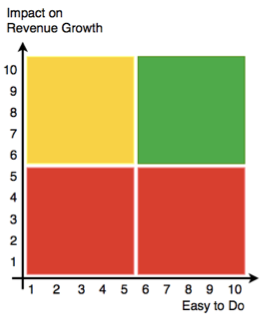
- Determine the quality of these ideas. Use these two questions to rate and rank the ideas: Plot your idea on the 4 quadrant chart below. Ideas with the most potential revenue growth that are also the easiest to do will be in the top right quadrant. Ideas that have strong potential impact yet take more resources or are less easy to do will be in the top left quadrant.
- What is the potential impact for revenue growth? Rate it from 1 to 10. A higher rating means that it has more positive impact on revenue growth over the next 3 years.
- How easy is it to do? Consider the resources, current skills and current projects. Rate it from 1 to 10 on how easy it is to get done. A higher rating means that it is easier and less resource-intensive to get done over the next 3 years.
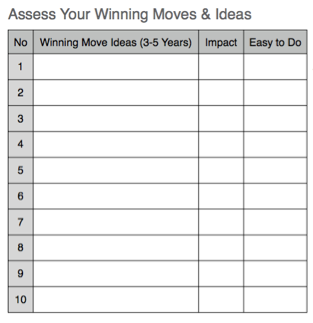
- Categorize the ideas. Discuss and choose the top 2-3 ideas for your winning moves. Put the other ideas onto your idea bench. Today's idea on the bench could be tomorrow's Winning Move idea. Don't throw away ideas.
- Confirm and make it happen! Discuss these ideas and choose the 2 or 3 that the team can get focused on over the next 3 years.
At the end of the session, the founder and CEO shared with me that this process allowed him to put his idea on the table and receive feedback from the team without torpedoing other ideas. As it turned out, his idea ended up being rated in the bottom left quadrant - lower impact and more resource-intensive or less easy to do. He was thrilled that this process allowed him to be open to other team members' ideas. It also provided an objective way to discuss and process all the ideas, without his idea automatically being chosen by virtue of his title and position in the company. He shared these benefits that he observed with me:
- We were able to get ideas on the table and discuss them without any team member feeling attacked or minimized as we discussed and rated the ideas on potential revenue impact and how easy it would be to get done.
- My idea (CEO's idea) did not get extra points just because it came from me, and that was ok.
- We chose the top 3 ideas that the whole team believed were the best in an objective and unemotional way.
- I feel emotionally excited and optimistic about the future.
If you are mastering the Rockefeller Habits, pull out your One-Page Strategic Plan and review your 3-5 year plan found in column 3. Do you have 2-3 Winning Moves documented? If you don't, set a date now for your team to come together and get on a Think Rhythm to work on developing Winning Moves for growth.

Looking for more help implementing the Rockefeller Habits? Check out our additional resources:
The Daily Huddle: A Key Component in Mastering the Rockefeller Habits
Power the Rockefeller Habits with Software
4 Tips to Mastering the Rockefeller Habits and Your One-Page Strategic Plan
Mastering the Rockefeller Habits' One Page Strategic Plan (OPSP)
Build a Healthy Foundation by Mastering the Rockefeller Habits: 4 Key Decisions
Simple Do's and Don'ts for Implementing Rockefeller Habits


Patrick Thean
Patrick is an award-winning serial entrepreneur, a WSJ and USA Today bestselling author, CEO Coach, and Co-founder of Rhythm Systems.
 Connect with me on LinkedIn.