

 All Articles
Annual strategic planning starts with choosing the few growth opportunities your leadership team can execute. Evaluate each opportunity for revenue impact and your ability to deliver, select your Winning Moves, and decide what you will stop doing to protect your team's focus.
Why Too Many Strategic Priorities Weaken Execution
In October, leadership teams start planning for the year ahead, and I see the same mistake again and again: too many priorities. A new market, a new product, a pricing strategy, or a partnership. All good ideas. But effective priority setting requires choices about where your time, money, and energy will go.
I tell leaders all the time: You can't win by chasing every opportunity in front of you. You have to make choices.
Think of it like a buffet. Just because everything looks good doesn't mean you should put it all on your plate. You'll end up with indigestion!
Your team has limited time, money, and energy. Spread those resources across twelve initiatives, and you'll struggle to execute any of them well.
McKinsey found that companies in the middle of their industries had just an 8% chance of moving into the top fifth over ten years. But companies that made three bold, focused moves increased those odds to 47%.
That's the power of focus.
As you plan for 2027, don't ask, "What else should we be doing?"
Ask, "What are the few Winning Moves that will make the biggest difference in our business?"
What is a Winning Move in Strategic Planning?
In Rhythm Systems' approach, a Winning Move is a strategic growth initiative with the potential to double your business in three to five years. It gives your leadership team a clear growth opportunity to evaluate, rather than another incremental improvement to add to the annual plan.
You cannot cut your way to growth. Your annual planning process needs time to identify the opportunities that could change your business's trajectory and the discipline to choose which ones deserve your resources.
AvidXchange: Finding Growth in Existing Customer Relationships
One of my favorite examples is AvidXchange. By 2010, AvidXchange was already a leader in accounts-payable automation for the real estate industry. Business was strong, and they were winning, but their leadership team recognized something important: What got them here wouldn't necessarily get them to the next level. Rather than wait for growth to slow down, they started looking for their next Winning Move.
Through AvidInvoice, they already had relationships with their customers and their customers' vendors. They were also integrated into their customers' accounting systems. That combination created an opportunity to do something much bigger: offer online bill pay for businesses. In January 2012, they processed their first online payment. That Winning Move put them on a path to double their business in just 15 months.
But here's what I want CEOs and leaders to understand: this wasn't some brilliant idea that came out of nowhere. It was the result of years of disciplined quarterly planning sessions where the leadership team intentionally made time to step away from the day-to-day and think about the future of the business.
I hear CEOs say all the time, "We don't have time to think about strategy." My response? You don't have time NOT to. If you're too busy running today's business to figure out how you're going to grow tomorrow's business, you're putting your future growth at risk. Winning Moves don't happen by accident. You have to make time to find them.
Three Questions to Identify Your Next Winning Move
After working with hundreds of CEOs and leadership teams on their strategic plans, I've found that the best Winning Moves often come from asking three simple questions:
- What are your competitors unwilling to do that your core customers really need? Think about Blockbuster. Customers had to return DVDs to the same store where they rented them. Redbox changed that by giving customers more convenient return options. Sometimes your biggest opportunity is solving a problem your competitors have accepted as the norm.
- What do your customers hate but continue to tolerate? Think about the outrageous prices rental car companies charge to refill your gas tank. Customers may put up with these frustrations because they don't have a better alternative. That's an opportunity for a company willing to rethink the customer experience.
- Is there a diamond in your own backyard? Sometimes your next big growth opportunity is already sitting inside your business. That's exactly what happened with AvidXchange and AvidPay. They had the customer relationships, vendor connections, and technology in place. They just needed to recognize the opportunity and turn those existing assets into a new growth engine.
How to Prioritize Growth Opportunities by Impact and Execution
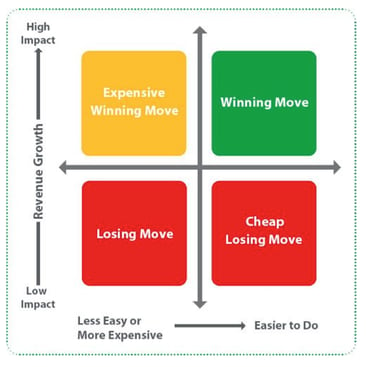
To prioritize growth opportunities, score each potential Winning Move from 1 to 10 on two factors: its potential revenue impact over the next three to five years and your team's ability to execute it with the resources you have today.
Use the Winning Moves Rating Scale to compare opportunities consistently. Give your attention to moves that score highly on both factors. A high-impact opportunity that is difficult to execute may still deserve consideration, but be explicit about the resources and trade-offs it requires.
But be careful. Those demanding moves require significant resources, and you can't afford to take on too many at once.
The goal isn't to walk away with the longest list of good ideas. It's to identify the few Winning Moves that can truly change the trajectory of your business.
Why Low-Impact Initiatives Distract From Your Strategic Priorities
Not every good idea is a Winning Move. In fact, some of the most dangerous distractions in your business are the initiatives that are easy to execute but deliver very little impact. I call these Losing Moves.
Nobody intentionally chooses a Losing Move. Most start as promising ideas with good intentions, but over time, the team realizes the results aren't what they expected. Instead of stopping, they keep going because the initiative isn't costing much money or seems easy enough to maintain. A Losing Move that's inexpensive is still a Losing Move.
What we often overlook is the true cost of these initiatives. They may not require a significant financial investment, but they consume your team's time, energy, and attention. Every hour spent on a Losing Move is an hour that could have been invested in a Winning Move that actually moves your business forward.
Protect Leadership Team Alignment With an Idea Bench
So how do you say no to good ideas without discouraging the people who bring them forward? I encourage leadership teams to create an idea bench. When someone brings a good idea to the table that doesn't align with your current priorities, don't dismiss it. Capture the idea, document how you evaluated it, and explain why it's not the right move right now. You're not necessarily saying no forever. You're saying, not now. This allows you to acknowledge the contribution while protecting your team's focus.
Once you've identified your two or three Winning Moves, build leadership team alignment around the choices and trade-offs. Your leaders need to help shape the strategy and take ownership of execution. Use quarterly execution planning to connect those growth opportunities to focused priorities your team can act on.
If your team sees a Winning Move as something a consultant or CEO forced on them, they will struggle to stay committed when execution gets difficult. Give your leaders a role in deciding what to pursue and what to stop doing.
Turn Your Winning Moves Into Focused Annual Planning Decisions
As you finalize your plans for 2027, I want to challenge you to think differently about where you're investing your team's time, energy, and resources. Your job as CEO isn't to pursue every good opportunity that comes your way. It's to create clarity around the few Winning Moves that will have the greatest impact on your business.
I love that because it's exactly what great leadership requires. You don't have to do everything; you have to make sure your team is focused on the right things.At your next leadership team meeting, use this priority-setting exercise to move your annual strategic planning from a list of good ideas to a focused set of growth decisions:Barry Pruitt says it best: "CEOs need to move from Chief Everything Officer to Chief Clarity Officer."
- Give everyone ten minutes to identify five to ten potential Winning Moves.
- Put the ideas on a whiteboard and have each person vote for their top three.
- Evaluate the five strongest opportunities for revenue impact and your team's ability to execute.
- Ask which one or two moves could double the business and what you will stop doing to give them the best chance to succeed.

Patrick Thean
Patrick is an award-winning serial entrepreneur, a WSJ and USA Today bestselling author, CEO Coach, and Co-founder of Rhythm Systems.
 Connect with me on LinkedIn.