

 All Articles
As your company grows, chaos increases, processes break down, and execution becomes a lot harder. Poor execution leads to missed commitments, disappointed customers, and disconnected employees.
As I discussed in my recent webinar, “A Proven System to 10X Growth,” our research tells us that poor execution comes from four key areas:
- Lack of Focus: Lack of focus happens when you overeat from the buffet of opportunities, therefore creating too many priorities and too many distractions.
- Lack of Clarity: Lack of clarity arises when you fail to define what success looks like and how to achieve it. If you can see it, you can do it–and if you can’t see it, you can’t do it.
- Lack of Alignment: Lack of alignment occurs when your team is aligned on desired results but not aligned on how to get there.
- Lack of Accountability: Lack of accountability happens when you miss commitments to your clients, employees, and other key stakeholders. Many people think that accountability is about administering consequences, but it is really about achieving goals.
How to Improve Performance in Each of the Four Areas
As a leader, you can help your team strengthen their execution by improving performance management in these four areas–and as an employee, you can take ownership of your own performance in these areas! To enhance performance, implement the following strategies:
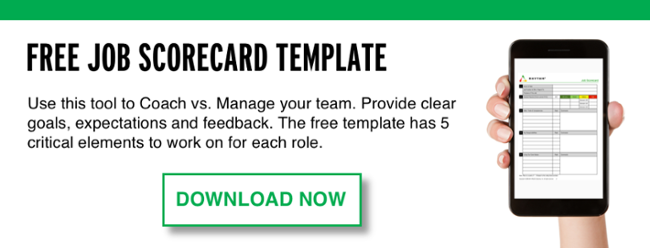
- To improve focus, empower each of your reports to build a Job Scorecard in conjunction with you. The Job Scorecard is instrumental to performance because every employee must understand their job really well in order to be a high performer. As your reports identify their role-critical KPIs and Priorities, remember that it is essential for them to say “yes” to a few things, but it is actually more important to say “no” to what is not needed. If they do not learn to say “no,” they cannot focus on what is most important to their role.
- To improve clarity, talk through what it means for them to achieve their KPIs and Priorities. Use Red-Yellow-Green criteria to help them clearly define what success and failure look like. This will allow them to begin their projects with the end in mind, but also to keep the end in mind for the quarter or year. They must visualize what they are going to accomplish and how they are going to accomplish it.
- To improve alignment, think cross-functionally. Most critical projects these days are complex and can be accelerated with expertise from other teams or departments. Coach your teams to involve other departments. Check for dependencies across the company that the team might not be aware of at first glance. Cross-functional alignment will ensure balls do not get dropped and minimize wait time as work gets passed between teams or departments. Alignment is not just top-down or vertical–it’s very much horizontal!
- To improve accountability, encourage your reports to take ownership of their commitments by visualizing and understanding how they will achieve their goals in a quarter. Every quarter is made up of 13 weeks, so think of the quarter as a 13-week Race. Visualize key milestones on your 13-week Race and document them so that the team can see and recognize where they are on track to achieve their goals. If they are off track, make the necessary adjustments. Get the team used to being accountable for reaching their goals weekly so that issues and risks can be identified early and solved as a team. This practice uses accountability to focus every team member on succeeding as a team instead of laying blame.
A growth company will experience chaos, but a high-performing team will be much better equipped to tame the chaos. To improve performance, get your teams focused, clear, aligned, and accountable to achieving their commitments. A team that excels in these four areas can consistently turn chaos into opportunities.
Check out these additional resources:

Patrick Thean
Patrick is an award-winning serial entrepreneur, a WSJ and USA Today bestselling author, CEO Coach, and Co-founder of Rhythm Systems.
 Connect with me on LinkedIn.