
 All Articles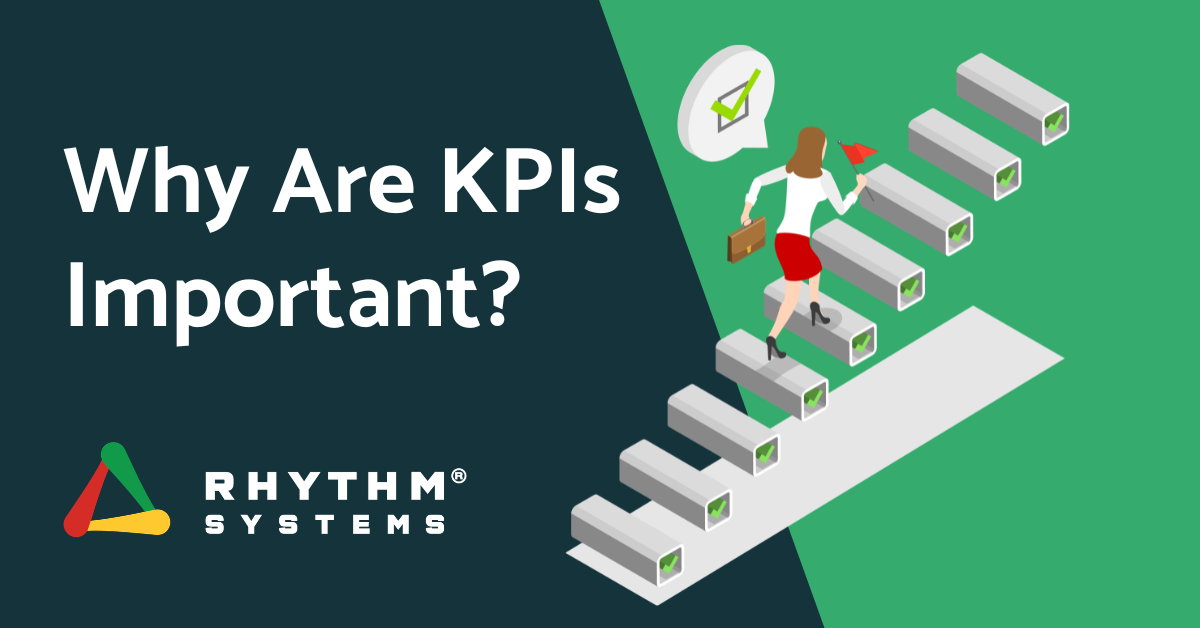
KPIs are the vital signs of your business. Just as a doctor uses heart rate, blood pressure, and oxygen levels to assess your health at a glance, your leadership team uses Key Performance Indicators (KPIs) to understand whether your company is thriving, struggling, or heading for trouble — before it's too late to act.
When onboarding new clients at Rhythm Systems, we hear versions of the same question all the time: "Why do we need KPIs? Our team already knows what success looks like." Sound familiar? The reality is that without the right metrics tracked consistently, most companies are flying blind — reacting to problems instead of preventing them.
Rhythm Systems has worked with hundreds of mid-market CEOs over 20+ years, and the pattern is consistent: the companies that grow predictably are the ones that know exactly what to measure, track it weekly, and use it to make better decisions faster. In this post, we'll break down why KPIs matter — and how to use them to get your team focused, aligned, and accountable.
What are KPIs, and Why Do So Many Companies Get Them Wrong?
Key Performance Indicators (KPIs) are quantifiable metrics that show how well your company is executing. A strong KPI is more than a number you report — it tells you whether you're on track, helps you catch problems early, and gives your team a shared language for what "good" looks like.
The most common mistake mid-market companies make? Measuring too much. When everything is “key,” nothing is. If you're tracking 40 metrics, how do you know which ones actually drive your results? The answer: you don't.
At Rhythm Systems, we recommend 8–12 KPIs to track company health. Choose them carefully, assign clear owners, and review them weekly. That discipline is what separates high-growth companies from those that stay stuck.
Research from ZS Associates found that high-growth mid-market companies (15%+ annual revenue growth) weren't tracking more KPIs than slower-growing peers — they were tracking better ones, sharing them more widely, and reviewing them more frequently. That's the Rhythm approach.
Why Are KPIs Important? 5 Reasons That Drive Real Results
Here's the practical case for KPIs — not as a theoretical framework, but as tools your team uses every single week.
1. KPIs Give You a Scorecard for Company Health
Think of KPIs as your company's vital signs. You don't need hundreds of them — you need the right ones, covering the four dimensions of a healthy business: Employees, Customers, Processes, and Revenue. When these are in balance, your company is healthy. When one spikes red, you know exactly where to focus.
In Rhythm's Think-Plan-Do™ system, KPIs are reviewed in your Weekly Adjustment Meeting as part of your Do Rhythm. That weekly check-in is what transforms data into decisions — and decisions into results.
2. KPIs Measure Progress Over Time
A KPI is only powerful when it's tracked consistently. Setting a target for the quarter and never looking at it again doesn't help anyone. The discipline of weekly tracking builds a feedback loop: you see what's moving, what's stuck, and what needs attention.
This is especially important for leading indicator KPIs — metrics that predict future outcomes rather than report past results. If your sales team tracks "# of discovery calls booked" every week, you'll know 30 days in advance whether you're on track to hit your revenue goal. That's an execution advantage.
3. KPIs Help You Make Adjustments Before It's Too Late
This is one of the most valuable and underappreciated reasons to track KPIs. When a metric turns yellow or red in Rhythm's Red-Yellow-Green system, it's a signal — not a verdict. You have time to course-correct.
Without consistent KPI tracking, that same problem becomes a crisis you're managing at the end of the quarter. KPIs are an early warning system. They let you fix a slow month before it becomes a bad quarter.
The rule is simple: if a KPI goes yellow, adjust. If it goes red, escalate. Never wait.
4. KPIs Help You Solve Problems and Capture Opportunities
One of the most powerful uses of KPIs is as a diagnostic tool. Say you're in a sales slump. Rather than guessing at the cause, you build a temporary dashboard: outbound calls made, demos scheduled, proposals sent, deals closed. Track it weekly for 6 weeks and you'll see exactly where the pipeline is breaking down.
The same logic applies to opportunities. Testing a new product, entering a new market, or launching a new initiative? Use KPIs to validate your assumptions before you scale. Rhythm clients regularly use their dashboards as a sandbox for smart, low-risk experimentation.
5. KPIs Reveal Patterns That Improve How You Plan
When you track the same KPIs quarter over quarter, patterns emerge. You might see that Q1 is consistently your weakest sales quarter — which means planning a major initiative then is risky. Or you notice that your NPS score dips every time you add headcount too fast, a signal that your onboarding process needs work.
This kind of institutional knowledge lives in your data, not in anyone's memory. KPIs give you a historical record that makes every future planning session smarter.
Ready to identify the right KPIs for your company? Download Rhythm's free KPI Guide: KPIs That Drive Predictable Results — a practical toolkit used by 500+ mid-market leadership teams.
What Does a Strong KPI Dashboard Actually Look Like?
A healthy KPI dashboard isn't a spreadsheet with 50 rows. It's a balanced view of your company that covers the metrics that matter most — and nothing else. Rhythm recommends at least 2 KPIs from each of these four perspectives, with at least one being a leading indicator:
- Financial Perspective: Net profit margin, revenue growth, gross margin
- Customer Perspective: NPS (Net Promoter Score), repeat customer rate, customer acquisition cost
- Internal/Operational Perspective: Revenue per employee, capacity utilization, on-time delivery
- Employee Perspective: Employee NPS, turnover rate, employee engagement score
This approach mirrors the balanced scorecard framework — and for good reason. If you only track financial KPIs, you'll miss the leading signals that drive them. Employee engagement today predicts customer satisfaction tomorrow. Customer retention today drives revenue next quarter.
Each KPI in Rhythm has a clear Red-Yellow-Green success criteria agreed upon by the team. Green means you're meeting your target. Yellow means an adjustment is needed. Red means escalate — now. And SuperGreen means it's time to celebrate. This shared language eliminates ambiguity and makes your weekly review conversations sharper and faster. Want to go deeper on building your dashboard? Read How to Create Company KPIs That Drive Success.
How AI Is Changing the Way Teams Use KPIs
KPI tracking has always required discipline. AI is making that discipline more accessible — and more powerful.
Your team can now use AI to help draft KPI definitions, identify the right leading indicators for a given goal, or flag anomalies in your data before your weekly meeting. Rhythm Intelligence (RI), Rhythm's built-in AI layer, is designed to do exactly this — surfacing insights from your dashboard so your leadership team spends less time compiling data and more time acting on it.
That said, the decision still belongs to you and your team — not the AI. What KPIs to track, what success looks like, and what actions to take when something goes red: those are human calls. AI makes you faster and sharper. It doesn't replace the judgment that comes from knowing your business, your team, and your market.
A Real Scenario: Using KPIs to Turn Around a Struggling Quarter
Imagine a 200-person professional services firm. Their revenue is flat, but no one can pinpoint why. The CEO suspects it's a sales pipeline problem; the VP of Sales thinks it's a capacity issue on the delivery side.
They build a focused KPI dashboard with five metrics: proposals sent per week, proposal-to-close rate, average project value, utilization rate, and client NPS. They track it weekly for six weeks.
The data tells a clear story: proposal volume is strong, but the close rate has dropped from 42% to 28% over three months. Client NPS is steady, so delivery isn't the problem. The team digs in — and discovers that a competitor recently cut pricing significantly, and their sales team wasn't equipped to handle the objection.
Six weeks of KPI tracking turned a vague revenue problem into a specific, solvable challenge: competitive positioning and sales training. They address it in their next quarterly plan. By Q3, their close rate is back above 40%.
That's the power of the right KPIs tracked in a consistent rhythm. Not more data — better data, reviewed regularly, acted on quickly.
What Makes KPI Tracking Actually Work — 5 Things That Matter
The tool isn't the problem. Most companies that struggle with KPIs aren't missing software — they're missing these habits:
- Weekly review cadence: KPIs reviewed less than weekly are lagging indicators of a lagging indicator. Build review into your Do Rhythm.
- Clear ownership: Every KPI needs one owner — not a committee. The owner updates it, explains it, and is accountable for it.
- Agreed success criteria: What does green look like? What triggers a red? Alignment on this before the quarter starts prevents arguments mid-quarter.
- Leading + lagging balance: Mix metrics that show where you've been (lagging) with metrics that predict where you're going (leading). The latter are your execution levers.
- Restraint: If everything is important, nothing is. Limit your dashboard to the KPIs that genuinely drive your most critical goals. Quality over quantity, every time.
Start Measuring What Moves the Needle
KPIs aren't a reporting exercise. They're a leadership tool — one that helps your team stay focused on what matters, catch problems before they compound, and make smarter decisions faster.
The companies Rhythm Systems works with don't just have KPI dashboards. They have a Think-Plan-Do™ rhythm built around them — annual plans that set the strategic direction, quarterly plans that define the priorities, and weekly meetings that use KPI data to drive real-time adjustments.
If you're ready to build a KPI system that actually drives results, start with our free KPI Guide: KPIs That Drive Predictable Results. It's the same framework we've used with hundreds of successful mid-market leadership teams — and it will help you identify the right metrics, set clear success criteria, and put your team on the path to more predictable growth.

Jessica Wishart
Jessica is Senior Product Manager at Rhythm Systems. She has experience in Client Services and Rhythm software technical support. Her background is in Organizational Execution.
 Connect with me on LinkedIn.