

 All Articles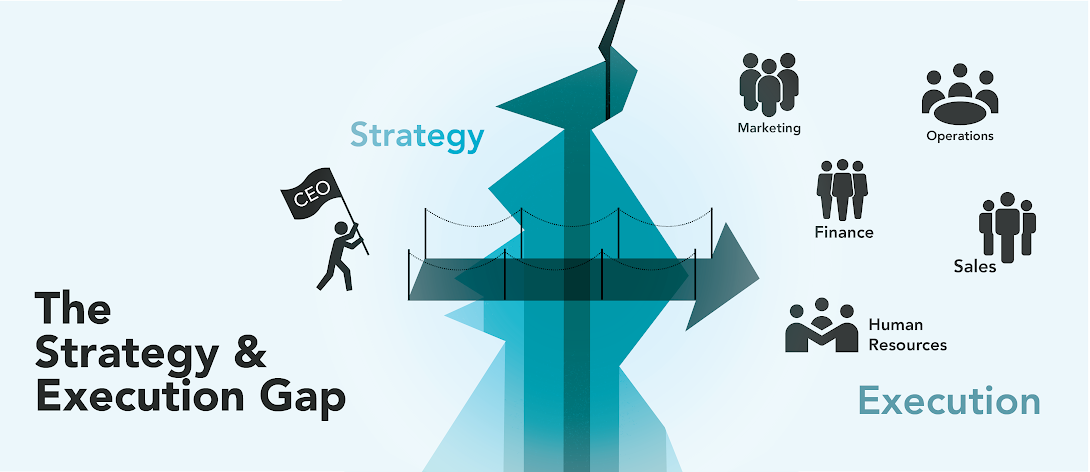
If a company doesn't achieve at least 90% of the strategic targets defined in its annual plan, the CEO has a strategy execution gap. It's rarely caused by a bad strategy — it's caused by what happens to communication and accountability as a company grows.
Strategy Execution Gap Research Findings
- A survey of more than 400 global CEOs found executional excellence was the #1 challenge they faced, ahead of roughly 80 other issues.
- In a study of 8,000 managers across 250+ companies, respondents were three times as likely to miss performance commitments due to insufficient support from other units.
- In a study of 144 C-level executives, only 10% said they implemented two-thirds or more of their core strategic initiatives in a given year.
Books and articles about strategy outnumber those about execution by nearly ten to one, but the execution gap, not the quality of the strategic plan, is where most companies actually lose ground. Good companies have a solid 3–5 year strategic plan. Great companies pair it with execution-ready quarterly plans that translate that plan into weekly action. (For a full breakdown of what strategy execution itself involves, see What Is Strategy Execution?.)
How Is the Strategy Execution Gap Created?
Ironically, the gap is created by success. In a company's early days, everyone knows the strategy and their role in it. As the company grows and hires more people, strategy gets filtered through layers of management and compressed into "here's what I want you to do." Questions get deflected. Silos form and calcify. The company becomes more concerned with efficiency than effectiveness: everyone is doing things right, but the company has quietly stopped doing the right things.
At this stage, the shared sense of mission that united the early team is gone. Whatever organic growth continues comes from a small group of highly effective people still focused on what matters. When organic growth stalls, CEOs often turn to M&A to find it elsewhere, but the vast majority go into these deals without prior M&A experience, which tends to import a second culture's silos on top of the first and widen the execution gap rather than close it.
How Do CEOs Close the Strategy Execution Gap?
The challenge is two-fold:
- Most employees in mid-to-large companies don't know the vision or strategy.
- The CEO and senior leadership generally don't know what most employees are working on on any given day.
Closing the gap means making both strategy and execution everyone's job, not just the executive team's. Every employee needs to understand and believe in the strategy, and leadership needs real visibility into what's happening at the execution level.
This is exactly the gap a platform like Rhythm is built to close. Rhythm's weekly rhythm — Red-Yellow-Green status tracking reviewed in a Weekly Adjustment Meeting — gives CEOs and department leaders visibility into what's failing early enough to fix it, and what's working well enough to replicate it, instead of finding out at the next quarterly review.
Frequently Asked Questions
What is the strategy execution gap? The gap between the strategy leadership develops and the results the company actually delivers. As a rule of thumb, failing to hit at least 90% of the targets in the annual plan signals a strategy execution gap.
What causes the strategy execution gap? Success and growth, ironically. As a company adds people and layers of management, strategy gets compressed and diluted, silos form, and the organization shifts from effectiveness (doing the right things) to pure efficiency (doing things right).
Does M&A help close the execution gap? It often makes it worse. Most CEOs pursue M&A without prior experience integrating two cultures, which tends to compound the silos and communication gaps that caused the execution problem in the first place.
How do CEOs close the strategy execution gap? By making strategy and execution the responsibility of everyone in the company, not just leadership — every employee understanding and believing in the strategy, and leadership having real visibility into what's happening week to week, not just at quarter-end.
How does software help close the strategy execution gap? A platform like Rhythm keeps every department working synchronously with real accountability, giving leaders execution-level visibility so they can fix what's failing quickly and replicate what's working.
Frequently Asked Questions
What is the strategy execution gap?
The gap between the strategy leadership develops and the results the company actually delivers. As a rule of thumb, failing to hit at least 90% of the targets in the annual plan signals a strategy execution gap.
What causes the strategy execution gap?
Success and growth, ironically. As a company adds people and layers of management, strategy gets compressed and diluted, silos form, and the organization shifts from effectiveness (doing the right things) to pure efficiency (doing things right).
Does M&A help close the execution gap?
It often makes it worse. Most CEOs pursue M&A without prior experience integrating two cultures, which tends to compound the silos and communication gaps that caused the execution problem in the first place.
How do CEOs close the strategy execution gap?
By making strategy and execution the responsibility of everyone in the company, not just leadership — every employee understanding and believing in the strategy, and leadership having real visibility into what's happening week to week, not just at quarter-end.
How does software help close the strategy execution gap?
A platform like Rhythm keeps every department working synchronously with real accountability, giving leaders execution-level visibility so they can fix what's failing quickly and replicate what's working.

Cindy Praeger
Cindy is a Serial Entrepreneur who has a passion for helping companies scale. She is the Co-Founder of Rhythm Systems, and loves helping growing organizations make breakthroughs to achieve their dreams and goals.
 Connect with me on LinkedIn.