
Note: This content reflects our Premium software's default features and labels. For any questions, please email help@rhythmsystems.com.
How to Set Red-Yellow-Green Success Criteria
Begin with the End in Mind by documenting what constitutes success and failure for each of your goals. When you are building your plan at the beginning of each quarter, define the following for each goal:
- Red = Failure or unacceptable result
- Yellow = Between Red and Green
- Green = Successful outcome
- SuperGreen = Stretch Goal
Setting success criteria will help you make each of your goals SMART:
- Specific
- Measurable
- Achievable
- Results-focused
- Time-bound
Tips for writing good criteria
- Use numbers with Format as Number for KPIs — it's the most objective way to track progress.
- For Priorities, describe the successful outcome tactically rather than assigning a number.
- Keep criteria short and clear.
- Be realistic within the timeframe you've chosen.
- Avoid using dates or "% complete" as criteria — describe the outcome instead.
- Agree on criteria together during planning so everyone's aligned before the period starts.
- Rhythm Intelligence can suggest success criteria — click the suggestion icon, and use reset for a fresh set if the first suggestion isn't right.
Choosing a time horizon
Success criteria can be set at four levels of granularity:
|
Criteria type |
You pick this app-level context |
Columns you'll see |
|---|---|---|
|
Weekly |
A quarter (e.g., Q4 2026) |
Week 1 through Week 13 of that quarter |
|
Monthly |
A quarter (e.g., Q4 2026) |
The three months in that quarter |
|
Quarterly |
A year (e.g., 2026) |
Q1, Q2, Q3, Q4 of that year |
|
Annual |
A year (e.g., 2026) |
The selected year plus the year before and after |
A goal can have criteria stored for more than one time horizon at once — switching which one is "active" (see below) never deletes the others.
NOTE: Status Frequency must be equal to or more frequent than your criteria's time horizon. For example, Weekly criteria require a Status Frequency of Weekly or Any Day. If you try to set criteria more granular than your Status Frequency, Rhythm will prompt you to fix one or the other.
Which time horizon is "active"
A goal's Criteria Type setting (in Additional Details, or the goal's Edit dialog) determines which time horizon's criteria is shown by default and used to drive status color. You can change this setting at any time:
- Switching Criteria Type is a view change, not a destructive one — if the goal already has criteria saved for the type you're switching to, that data appears as-is; if not, you'll be prompted to enter it.
- Data for a time horizon you're not currently viewing is preserved untouched.
Where you see success criteria
- On the goal detail page: a read-only Success Criteria panel sits below the 13 Week Race, showing the columns for your goal's active Criteria Type.
- In the status side panel, Summary screen, table views, and the goal Edit dialog: these all show the same criteria, and all route you to the same editor (below) when you need to make a change.
Editing success criteria
However you get there, editing always opens the same Edit Success Criteria popup — this is intentional, so the editing experience doesn't change depending on where you started.
- Click into any success criteria field (from the panel, side panel, Summary screen, table view, or Edit dialog).
- The popup opens showing the relevant period — for example, "2026 annual criteria" or "Week 8 criteria."
- Enter your Red, Yellow, Green, and (optional) SuperGreen values for that period.
- To edit a different period, use the pop-out button near the time horizon label at the top of the popup — this works the same way for every horizon (jump between weeks, months, quarters, or years without closing the popup).
- The editor is draggable within the popup, so you can move it aside to check other values while you work.
- Click Save.
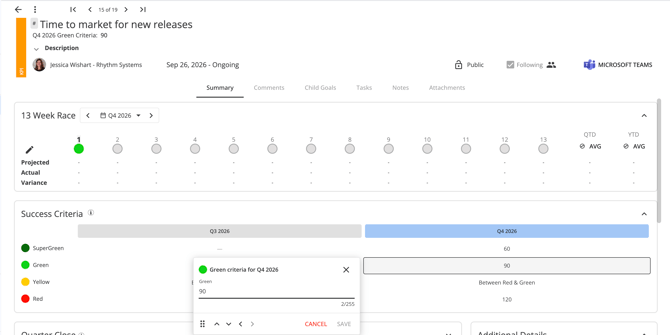
NOTE: When you set Week 1's criteria, Rhythm automatically fills Weeks 2–13 with the same values if they're empty — you only need to enter values for weeks where the target actually changes.
Format as Number
For goals where success is a number — most commonly KPIs — turn on Format as Number to get precise, operator-based criteria instead of free text.
- The toggle defaults ON for the KPI goal type and OFF for all other goal types. Changing a goal's type updates the default accordingly, though you can override it.
- When it's on, each band (SuperGreen, Green, Yellow, Red) gets its own operator (for example, >, or a range like [10, 20]), a number field, and an optional description.
- With the toggle on, the Projected/Actual/Variance fields only accept numeric input — this keeps your Auto Status Color settings working correctly (see Customizing Goal Settings).
- This same operator + number + description format shows up consistently everywhere the goal's criteria appear: the goal detail page, goal list views, and the status side panel.
- If Format as Number is off, criteria stay as free text.