

 All Articles
We have all heard the saying "A fish rots from the head down," right? Not that I am comparing my CEO friends to fish, but it does drive the point home that creating a culture of innovation starts with you as the leader of the organization.
Peter Drucker, one of the fathers of modern business theory, said if an established organization is not able to innovate, it faces decline and extinction. I could not agree with him more, for in all of my years helping companies, I have witnessed far too many that wait until they are in decline or experiencing shrinking markets, stale product offerings or products that are being commoditized to begin innovating. They usually do not have the resources once in decline to be successful, which is why it is important to build a culture of innovation while your business is strong and healthy.
So, what is an innovative culture? I came across this definition by Nicola Hepburn that I think describes it well while doing some research on the subject a couple of years ago. “A culture of innovation is an environment that supports creative thinking and advances efforts to extract economic and social value from knowledge and, in doing so, generates new or improved products, services or processes.”
Some very innovative companies of our time such as 3M, Amazon, Samsung and Rubbermaid, have all succeeded brilliantly in creating cultures of innovation. They introduce more new products and hold more patents than most others you know. I believe you can do the same if you make it a personal priority.
Common Problems a Lack of Innovation Creates
-
Pressure from competition
-
Lost market share
-
Pricing pressure
-
Low margins
-
Loss of key people
-
Trouble attracting the best talent
So, one of the first steps in avoiding these problems is to create a culture of innovation.
5 Ways a CEO Can Help Drive Innovation
1. Assess Your Current Culture.
Here are some questions you can ask to get started:
- Have you designed & implemented an innovation strategy? This spells out how you will embed and systematize innovation in your company and turn it into an ongoing measurable, manageable process.
- Do you have an environment of openness? You need to have trust so that it’s okay to take risks, make mistakes and try again.
- Does everybody in the organization believe they can and do play a part in innovating? Examine the attitude toward innovation and individual contributions.
- Do you allow failure to occur as long as learning takes place? This is often the best way to learn and make breakthroughs.
- Do you reward innovation? Reward financially when possible, along with recognition, to promote the desired behavior.
- Does your company’s culture currently support and reward innovation?
2. Measure Innovation.
What gets measured gets done and improved. This is the Rhythm KPI scorecard approach. Design and monitor innovation metrics in each of these 4 areas.
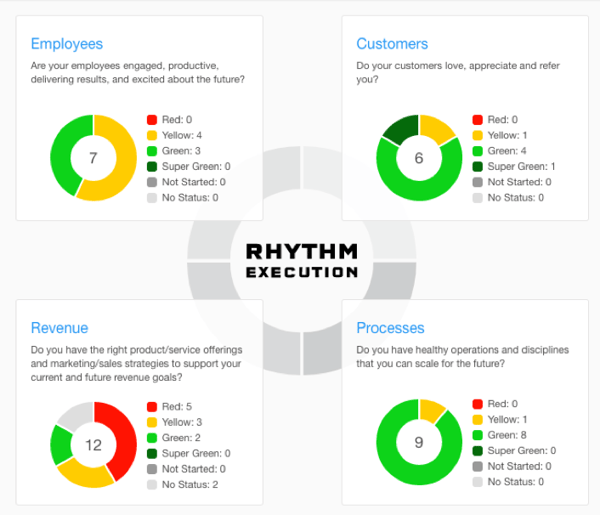
Here are some examples of KPIs you might measure around innovation to get you started.
Employees:
- # of employees submitting ideas
- Mix of creative types
Customers:
- Market share growth in a particular segment
- New customers from new products or services
- Customers on new product/on old products
Revenue:
- Percent of revenue from new products
- Investment in new products as a percent of revenue
- Percent of revenues for markets outside the USA
- Profit from new products or services
Processes:
- Number of patents
- # of ideas in the pipeline
- # of ideas brought to market
- # of ideas killed
3. Build an Innovative Team.
Balance the mix of people to create a conducive culture for innovation.
Identify and develop champions that can carry the torch. Shepherd, nurture and develop people.
Identify and recruit innovators, people who think creatively. These are the big idea people, who think beyond incremental innovation and have broad interests, are problem solvers, and are resourceful.
Identify mavericks – non-conformists, people who are not afraid to break the rules and existing paradigms. These people also are not afraid to blow things up and start fresh.
4. Create Processes & Structure.
Describe your current process for innovation – Do you have one? Is it working? Is it repeatable? Is it generating the quality of marketable solutions? Does everyone in the company know how they fit in?
Improve or change the system If it’s not working, do something about it. Kill it or make the right adjustments to improve it.
Create a repository for ideas. Use the Idea tool in Rhythm or a similar tool like Rhythm Winning Moves. You need a way to evaluate and work your ideas. Kill the ones that are duds, and bring the good ideas to life.

5. Allocate Sufficient Resources.
Address the lack of time barrier – Give people time to work on their projects and ideas. 3M allows 15% of employees time to work on new ideas.
Create a budget for innovation – innovation costs money. You need to plan for it and do it while you are profitable. As I said, I have seen too many companies realize they need to innovate when it’s too late and they are struggling.
Determine levels of risk – how much are you willing to invest and risk on one idea? Better to fire bullets before cannonballs and spread the risk. Fail fast, fail cheap when possible.
Remember, “Innovation is 10% inspiration and 90% perspiration” according to Thomas Edison.

Alan Gehringer
Alan is a Rhythm Consultant. He has years of experience helping clients get into a strong Think Plan Do Rhythm to profitably grow their business with purpose. He is an expert meeting facilitator, critical thinker, lifelong learner and a good listener. He is committed to helping clients reach their business goals by drawing on his experience and family business background.
 Connect with me on LinkedIn.