

 All Articles
If you've ever walked out of a planning session feeling energized, only to look up three months later and wonder why nothing actually changed — you're not alone. It's one of the most common frustrations we hear from leaders: "Everyone seems busy, but we're not making progress on the things that actually matter."
The culprit is almost always accountability — or, more specifically, the absence of an effective system for it.
At Rhythm Systems, we've spent nearly two decades helping high-growth companies build teams that are focused, aligned, and accountable. Out of that work, we developed a framework that we use with our clients (and on our own team) every day: The 5 Cs of Team Accountability.
It sounds simple — and it is. But in practice, it can completely change the way you lead.
What is Team Accountability, Really?
Before we dive in, it's worth addressing a misconception. Most leaders think of accountability as something you apply after things go wrong — a consequence, a hard conversation, a performance improvement plan. And while that's part of it, real accountability starts long before a deadline is missed.
True team accountability is about creating the conditions where people want to follow through — and know exactly what's expected of them when they do.
That's the key idea behind the 5 Cs.
The 5 Cs of Team Accountability Framework
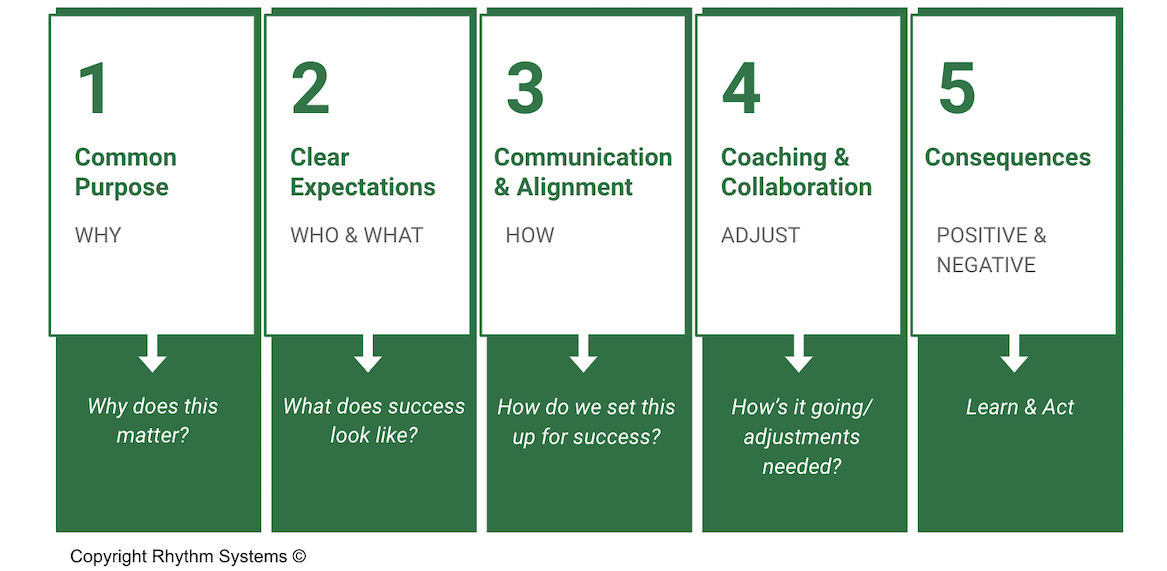
The five components are:
- Common Purpose
- Clear Expectations
- Communication and Alignment
- Coaching and Collaboration
- Consequences and Results
You can use this framework proactively at the start of a new project, or diagnostically when something has gone off track. Either way, it works.
Here's what it looks like in practice with a few real-world examples.
Real-World Accountability Examples
Example 1: Leading an Internal Systems Overhaul
A few years ago, my team took on a significant project: auditing and streamlining our internal systems. We had accumulated too many tools, which was hurting productivity and costing us money. Change is hard — especially when your team is already stretched. So before we kicked anything off, I used the 5 Cs deliberately.
1. Common Purpose
Before announcing any changes, I brought in all the key stakeholders. I started not with what we were changing, but why. I connected the project to our company's longer-term goals and explained what it would mean for each individual on the team — not just in abstract terms, but specifically. What would be easier? What would go away? When people understand the "why" in a way that's personal to them, you get genuine buy-in rather than grudging compliance.
2. Clear Expectations
Once we had alignment on purpose, we got specific. Our cross-functional project team created priorities in Rhythm with Red-Yellow-Green success criteria that clearly outlined our goals, milestones, deadlines, and dependencies. We thought carefully about timing based on team availability. Ambiguity is the enemy of accountability — the more specific you are upfront, the fewer surprises you'll face later.
3. Communication and Alignment
We shared weekly progress updates in our Weekly Team Meeting and made our quarterly priorities visible to the entire company in our Rhythm dashboard. When it came time to roll out new systems, we offered group training, one-on-one follow-up, short video how-to clips, and written documentation — because people absorb information in different ways. We also closed the loop by tracking actual adoption, not just whether the training happened.
4. Coaching and Collaboration
When we found some team members weren't using the new systems, our first response wasn't frustration — it was curiosity. We asked: Is this a skill gap? A clarity gap? Is something else getting in the way? Once we understood the barrier, we coached toward a solution. We also created space for team members to share feedback and best practices, which ended up strengthening adoption across the board.
5. Consequences and Results
We celebrated — loudly and specifically. At a company-wide meeting, we recognized the nearly year-long effort and shared the results: thousands of dollars saved, concrete time savings, and a more seamless experience for our clients. Celebrating wins is just as important to an accountability culture as addressing failures. Both matter.
Example 2: Diagnosing a Missed Sales Task
Now let's flip the script and use the 5 Cs as a diagnostic tool — because that's where it really shines when things go sideways.
A new sales hire — let's call him Alex — was asked by his manager Susan to make follow-up calls to a list of hot prospects on a Friday morning. When Susan checked in the following week, the calls hadn't happened. Rather than defaulting to frustration or blame, Susan worked through the 5 Cs with a coach.
1. Common Purpose
Susan assumed Alex knew why these calls were urgent — they were fresh leads from an event the day before, the kind that go cold fast. But she had never said that. She hadn't shared the why. And without the why, the task was just another item on a long list. Assumption is the enemy of common purpose.
2. Clear Expectations
There was no specific deadline given. "Make these calls" is open to interpretation. A clear expectation would have been: "Please make these calls today, by end of business — these leads will lose interest by Monday." Specificity isn't micromanagement. It's respect for the other person's time and priorities.
3. Communication and Alignment
Susan handed Alex a list and moved on. She didn't slow down to confirm he understood the urgency, the process, or the context. She also didn't check that the message actually landed. A two-minute conversation at handoff could have prevented the whole misunderstanding.
4. Coaching and Collaboration
Here's where Susan had a real breakthrough: Alex wasn't being defiant. He just didn't know what he didn't know. Susan recognized that she shared responsibility for what happened — and rather than treating it as a discipline issue, she treated it as a coaching moment. She committed to communicating more clearly. He committed to asking clarifying questions. Accountability flows both ways.
5. Consequences and Results
The missed calls meant missed opportunities. But Susan came out of the experience with a framework that would prevent this pattern from repeating. A failure became a teaching moment — and that's exactly what good leadership looks like.
How to Use the 5 Cs to Coach Your Team
One of the things I love most about this framework is that you can use it in a 1:1 without it feeling like an interrogation. Instead of asking "Why didn't you get this done?", you walk through the 5 Cs together:
- Did we both understand why this mattered? (Common Purpose)
- Was the deadline and scope crystal clear? (Clear Expectations)
- Did we stay in sync along the way? (Communication)
- Did you have what you needed to succeed? (Coaching)
- What are the results, and what do we do differently? (Consequences)
More often than not, you'll find the breakdown before you even get to consequences — and you'll both walk away with a clearer path forward.
3 Ways to Start Building Accountability on Your Team This Week
You don't have to overhaul everything at once. Start here:
- Run your next project kickoff through the 5 Cs. Before launch, ask: Have we established common purpose? Are expectations specific and measurable? Do we have a communication plan?
- Use the 5 Cs in your next 1:1. When someone isn't delivering, walk through the framework together. You might be surprised how often the gap is in the first three Cs — before consequences even come up.
Celebrate accountability wins publicly. When someone delivers on a difficult commitment, call it out in your next team meeting. Recognition reinforces the culture just as much as feedback does.
Take the Next Step
Building an accountable team doesn't happen by accident — it takes intentional leadership and the right systems to support it.
👉 Talk to a Rhythm Systems expert today to see how we can help your team get focused, aligned, and accountable.

Jessica Wishart
Jessica is Senior Product Manager at Rhythm Systems. She has experience in Client Services and Rhythm software technical support. Her background is in Organizational Execution.
 Connect with me on LinkedIn.